Jess Brown-Fuller, MP for Chichester, hosted the formal launch of the WBTi 2024 UK report on July 24th 2025 in the Jubilee Room at the Houses of Parliament.

(left to right) Patricia Wise, Clare Meynell, Jess Brown-Fuller MP with visiting baby Niamh, Helen Gray, Alison Spiro

Investigative journalist Kate Quilton drew on her own experiences in emphasising the importance of a policy framework, and chaired the Q&A.
What do policymakers need to do, to protect and support breastfeeding?
The WBTi 2024 report made a number of key policy recommendations on maternity rights, marketing regulations and food safety.

WBTi’s ‘big ask’
The aim of the WBTi project is to galvanise action to implement report recommendations, thus improving support and protection for infant feeding. Our single most immediate actionable ask is for the UK and devolved governments to adopt the eleven recommendations of the Competition and Markets Authority (CMA) report on regulating misleading infant formula promotion. Adopting these would help to end the profiteering we have seen in recent years (formula prices have gone up by 24%! including one by 49%!). This would also help families make informed infant feeding decisions and for them to be able to access affordable products to feed their babies if needed.
The CMA recommendations encompass many of the WBTi UK recommendations on protecting families from exploitative marketing. In addition, WBTi calls for the regulations to apply to ALL formulas from 0-36 months. This would help end the loopholes that companies use in the marketing of formulas for older babies and toddlers, or for special medical purposes.


Professor Nigel Rollins, who formerly worked for the World Health Organisation and is now at Queens University, Belfast, gave a policy overview and more details about our ‘Call to Action’.
Parents are struggling
Professor Amy Brown of Swansea university stunned the room when she revealed some of the shocking findings of her research into the challenges families are facing to afford the high prices of formula.
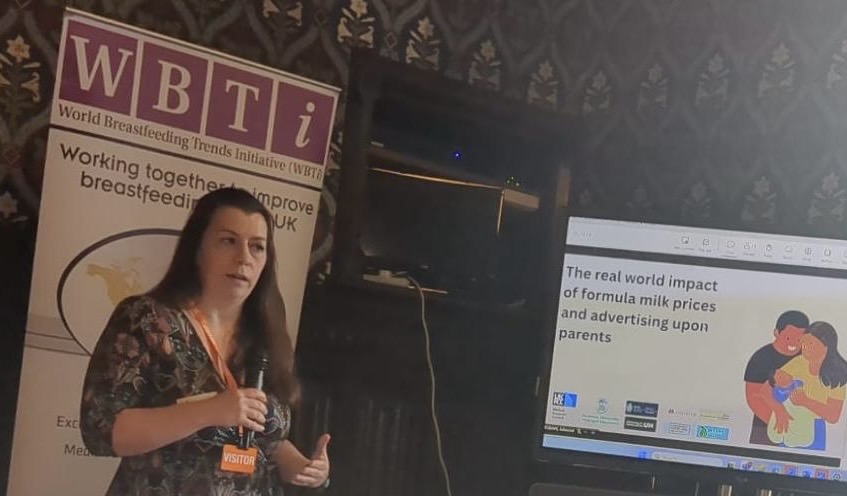
Her presentation called for:
- Lower priced milks – consistent, reliable and affordable pricing
- Accurate information, not adverts
- Parents should be supported to feed their baby without worrying about cost
- For the health and well-being of parents and babies to be put before profits
She shared powerful testimony about the impact of the high cost of formula from parents themselves:


Breastfeeding is important
“Breastfeeding is a human right for both mother and child” (UN human rights joint statement 2016).
WBTi work is built on a foundation of human rights. UN human rights experts have made it clear that breastfeeding is a right of the dyad, the mother and infant together. The rights of one don’t supercede the other; mother and baby have rights as a dyad. It is the responsibility of our governments to support and protect those rights, by providing skilled health care, maternity protection at work, and protecting the rights of women and families to make their own informed decisions about how to feed their baby, without commercial influence.
What is the impact of low breastfeeding rates in the UK?
High costs for the NHS:
Low UK breastfeeding rates are costing the NHS £millions:
- 54,000 more GP appointments
- 9,500+ additional hospitalisations
Research has shown that basic interventions to support more mothers to breastfeed for longer could pay for themselves within a year. (Renfrew et al 2012)
Costing our planet:
The formula and dairy industries have a significant footprint both of greenhouse gases and water.
“For the UK alone, carbon emission savings gained by supporting mothers to breastfeeding would equate to taking between 50,000 and 77,500 cars off the road each year” (Joffe et al 2019)
Key recommendations from the WBTi Core Group
Our governments must address the ‘baby blind spots’ in national policies:
- Protect all infants by adopting in full the recommendations of the CMA, and extending the regulations to cover all infant milks up to 3 years, in order to address current loopholes in marketing formulas for older infants or for special medical purposes.
- WBTi recommends that regulations on safety and on marketing should be applied to feeding equipment such as bottles, teats, and other equipment, as well.
- Protect infants and young children in emergencies by developing guidance on their care.
- Protect the health and the rights of women and children by providing statutory rights for flexible breastfeeding/ expressing breaks and suitable facilities in the workplace and in education.
- Develop a national infant feeding strategy and leadership for England.
- Improve monitoring and evaluation by strengthening and coordinating data collection systems.
Find our 2016 and 2024 reports here.
Sign up for our mailing list here (we send very few emails! And never share your details).
Donate to support our work here.
Author: Helen Gray

Helen is a member of the Steering Group for the World Breastfeeding Trends Initiative (WBTi) project in the UK.
An IBCLC and La Leche League Leader (breastfeeding counsellor), she has served as both Communications Co-Chair and Policy and Advocacy Lead for Lactation Consultants of Great Britain. She represents La Leche League of Great Britain on the UK Baby Feeding Law Group (BFLG), which works to bring the International Code of Marketing of Breastmilk Substitutes into UK law.
Helen’s background in anthropology and human evolution has influenced her interest in how breastfeeding and the way we nurture our babies are influenced by both human biology and culture.
She is currently doing a research degree on the need for strong policies to protect infant feeding in emergencies. She has written several articles and chapters on the subject and served on the Advisory Panel for a London Food Resilience research project. She now represents BFLG on the global Infant Feeding in Emergencies Core Group.
 Breastfeeding trends (UK)
One thought on “New WBTi Report: Parliamentary launch”