The Baby Friendly Initiative – a Global Building Block to Support Breastfeeding #WBW2022

The Baby Friendly Initiative – a Global Building Block to Support Breastfeeding #WBW2022

WHO and UNICEF launched the Baby Friendly Initiative (BFHI) over thirty years ago; three years later, UNICEF UK Baby Friendly Initiative (BFI) was born. The original BFHI framework of Ten Steps was created to improve maternity and hospital practices that undermined breastfeeding, such as separating mothers and their newborns or routine formula supplements, as well as implementing the International Code of Breastmilk Substitutes in maternity settings, in order to eliminate conflicts of interest with the baby feeding industry (companies that manufacture or distribute infant formula/milks, baby foods, feeding bottles and teats) such as promotion of formula milk in healthcare settings, or direct contact by companies with parents.

The Baby Friendly Initiative has changed the face of maternity practices and midwifery training in the UK – breastfeeding initiation has gone up about 20% since UNICEF UK BFI was founded in 1994. In this country, BFI has grown beyond maternity settings to create standards for infant feeding support programmes in the community and for universities training the next generation of midwives and health visitors. The BFI standards were revised in 2012, based upon the twin pillars of breastfeeding and the UN Convention on the Rights of the Child.

BFI standards in the community call for the integration of several levels of breastfeeding care:

  • Routine care: all staff in the universal services (midwives, health visitors, support workers etc) are trained to BFI standard with sound, evidence-based, basic training in supporting breastfeeding and responsive infant feeding. 
  • Additional services: every area should have additional support available, such as trained, skilled peer supporters who can act as an “informed friend” for new mothers, and a network of local peer support groups where new parents can find social support alongside help with everyday breastfeeding issues.
  • Specialist services: every area should also have a referral pathway for specialist care for more complex breastfeeding problems; breastfeeding specialists should have extensive experience or training such as the IBCLC qualification or a recognised breastfeeding counsellor/supporter credential, and either be a registered health professional themselves, or co-lead the specialist service with a registered health professional.
WBTi poster on Integrated Services to Support Breastfeeding, 2019

A good example of how the BFI community standards work is Harrow. Read more HERE about how WBTi UK Steering Team member and specialist health visitor Alison Spiro led Harrow’s local community health services through BFI accreditation, to develop a well integrated services and become 

the only local authority in the UK where breastfeeding was the ‘normal’ way to feed babies”

UNICEF assessment

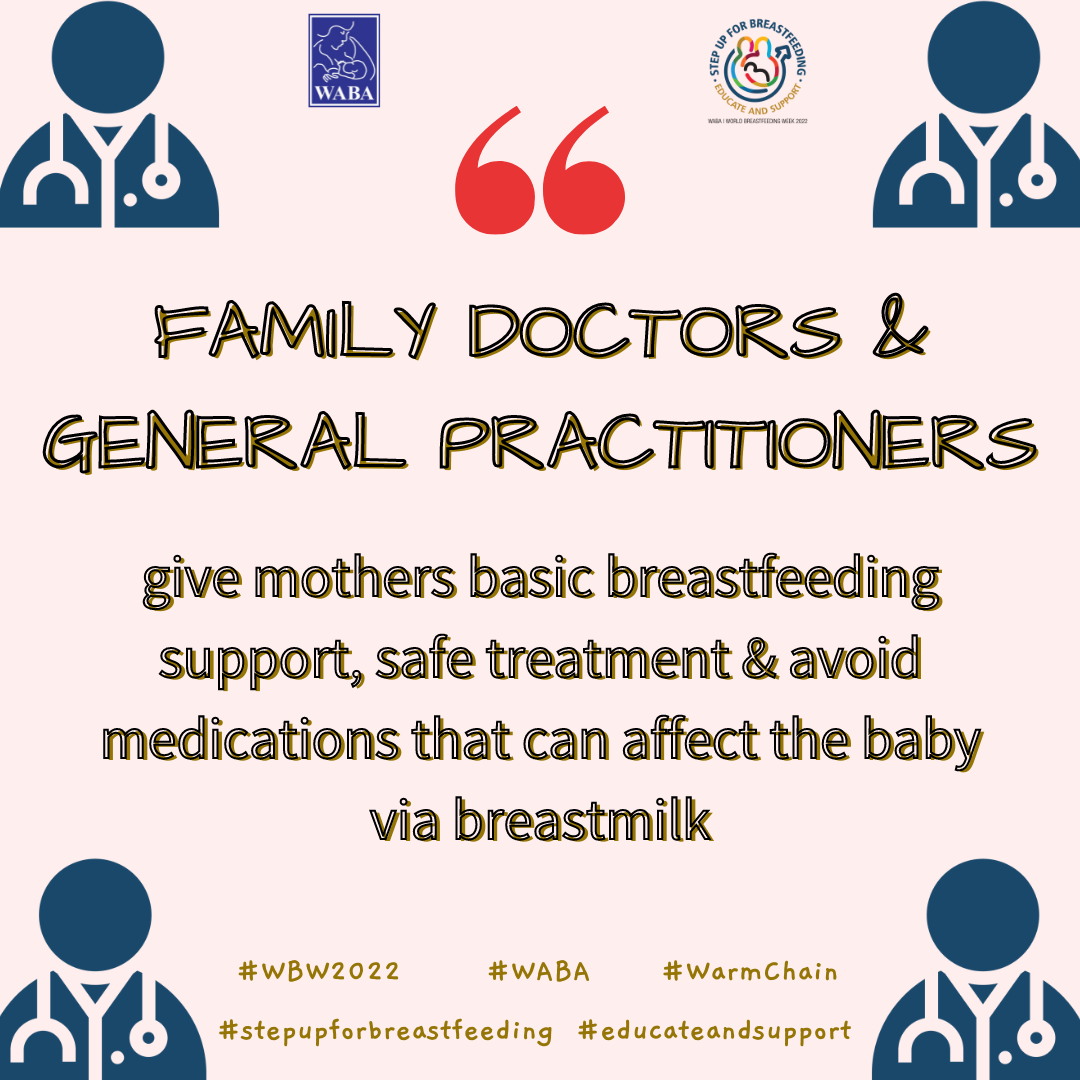
More recently, UNICEF UK BFI have produced Learning Outcomes for a wider range of health professions: medical students, paediatricians, pharmacists, paediatric/ children’s nurses, maternity support workers and nursery nurses. These will help to address the gaps in high level health professional training standards found in WBTI’s 2016 report. Every health professional who works with women, infants and children should understand the basics of lactation and breastfeeding management, prescribing during lactation, and how to refer parents on to local breastfeeding support.

#WBW2022 Webinar

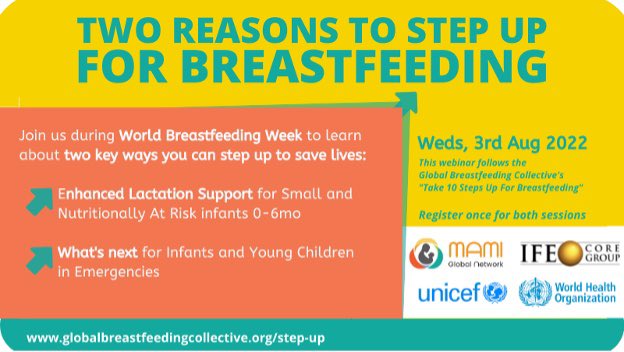
On Wednesday 3 August, we will all have the chance to learn more about the Ten Steps of BFHI in a webinar produced by the Global Breastfeeding Collective, an alliance of NGOs from around the world led by WHO and UNICEF.

In addition, there will be sessions on the care of young breastfed infants who are small or with faltering growth (the MAMI Pathway) and on infant feeding in emergencies. 

The entire webinar runs from 7-9 AM BST and again from 4-6 PM BST, and will be recorded.

Register HERE

Our WBTi #WBW2022 blog will cover these additional topics later in the week.

See you there!

This image has an empty alt attribute; its file name is h-gray-2021-dorset.jpeg

Helen Gray MPhil IBCLC is Joint Coordinator of the WBTi UK Steering Group.

Strengthen Health Professional Training in Infant Feeding #WBW2022

Strengthen Health Professional Training in Infant Feeding #WBW2022

Skilled health professionals are a fundamental building block for successful breastfeeding. Parents expect all healthcare professionals to have the knowledge and skills to help them overcome practical challenges and to offer them emotional support. The reality in the UK is that many have not received the training they need to do this, so parents do not always receive the support they need. While improvements have been seen, UK health professional training still shows gaps in training in infant feeding. Relevant, evidence-based training is needed for all those who work with women, infants and young children.

WBTi findings: mapping UK high level health professional training standards in infant feeding against the WHO Educational Checklist

WBTi’s research has found numerous gaps in the pre-registration training in infant feeding in almost all UK health professional specialisms. Only midwifery training covers most of the topics on the WHO’s Educational Checklist on infant and young child feeding.

Alarmingly, the worst gaps are in the high level training standards for nurses, including paediatric nurses. Since the publication of our first report in 2016, there have been a few improvements in the training standards set for paediatricians and GPs, and our upcoming reassessment will be mapping these against the WHO checklist.

What can YOU do?

If you are a health professional, urge your governing body to strengthen the requirements on infant feeding in your professional standards and examinations by:

Volunteer to help WBTi carry out the reassessment of UK health professional training standards.

Contact us: wbti@ukbreastfeeding.org

Helen Gray MPhil IBCLC is Joint Coordinator of the WBTi UK Steering Group.

#StepUpForBreastfeeding: We are the Building Blocks #WBW2022

#StepUpForBreastfeeding: We are the Building Blocks #WBW2022

It takes a village to raise a child – we all have a role to play to support breastfeeding mothers and babies. 

We all are the building blocks responsible for supporting new families: partners and family members, health workers, neighbours and community members, religious leaders, employers, academics, governments and policy makers. We can all make a difference. We need to step up to our responsibilities. Everyone needs to understand the importance of breastfeeding – for maternal and infant physical and mental health and wellbeing, for public health, for our economy, and for our planet.

For WBW this year, WABA has produced an extensive suite of materials looking at all these roles and responsibilities. They have outlined the challenges that breastfeeding families face at every stage from conception, through birth, getting breastfeeding off to a good start, and maintaining breastfeeding all the way through starting solids and going back to work, and the solutions we need in each situation – all backed up by links to the latest evidence. 

The #WBW2022 Action Folder pulls all this together: it is a useful resource for anyone using evidence to build policies and best practice. You can download it as a PDF and all the links to research and references will be live.

The UK WBTi team will be highlighting just a few of the concepts this week:

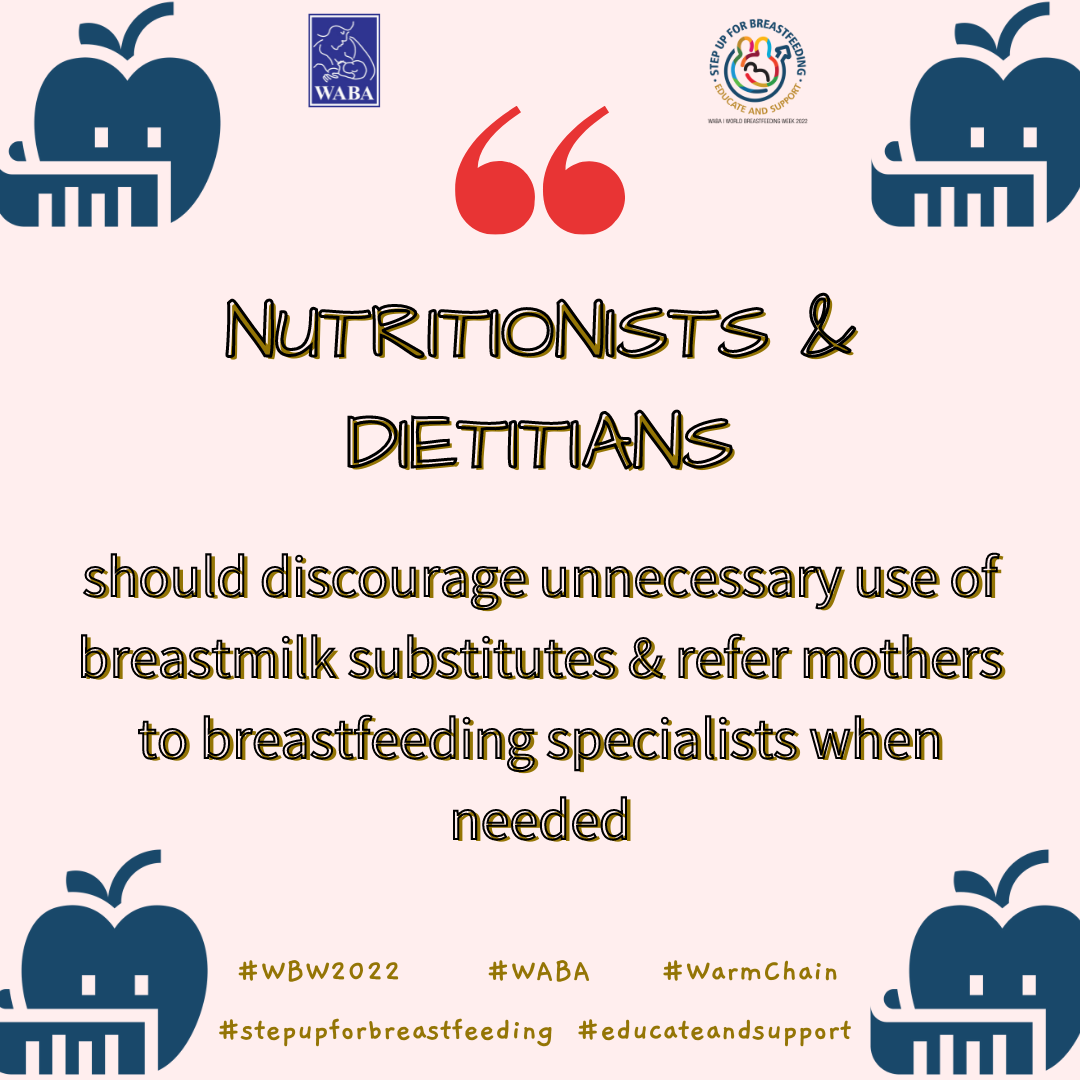
  • Health workers: the importance of relevant, evidence-based. The advertising of follow-on milks, on the media, from 6 months in the UK has led to confusion, resulting in some parents seeing formula milk as equivalent to breastmilk, or that breastfeeding should stop at 6 months.  The International Code needs to be adopted by the UK government in full, to reduce this confusion and protect breastfeeding. training for all those who work with women, infants and young children
  • UNICEF UK Baby Friendly Initiative and the BFHI worldwide sets out ways in which healthcare staff can receive sound, evidence-based, basic training in supporting breastfeeding. 

ALSO join a special webinar from the Global Breastfeeding Collective on BFHI, with some added specialist topics on supporting small and underweight breastfeeding infants, and on infant feeding in emergencies. (7-9 AM BST and again at 4-6 PM BST). Register HERE

  • Community support: Access to skilled, integrated support for all, with a special focus in the GBC webinar on how to support breastfeeding infants who are not gaining well (NICE NG 75,2017). All parents should have easy access to trained healthcare staff- midwives, paediatricians, health visitors and GPs- breastfeeding peer supporters and specialist support (IBCLC, BFCs). Supporting breastfeeding in complex circumstances: Specialist support from IBCLCS, BFCs, or infant feeding leads, integrated with specialist healthcare teams 
  • Protecting infants and young children in emergencies. National policies should guide Local Resilience Forums but these do not exist at present. 
  • The impact of misleading marketing: The International Code. The advertising of follow-on milks, on the media, from 6 months in the UK has led to confusion, resulting in some parents seeing formula milk as equivalent to breastmilk, or that breastfeeding should stop at 6 months.  The International Code needs to be adopted by the UK government in full, to reduce this confusion and protect breastfeeding.
  • Governments with national and local policy makers need to protect all families and support them to make informed feeding decisions free of commercial influence.

What can YOU do?

It is time for a reassessment of the UK’s national infant feeding policies and programmes. YOU could help! Volunteers are welcome with knowledge in any of the ten policy areas (Indicators 1-10), or with skills such as research, writing, graphics, social media and more – feel free to contact us for a chat!

WBTi Key Indicators:

Indicator 1: National policy, programme and coordination
Indicator 2: Baby Friendly Initiative
Indicator 3: International Code of Marketing of Breastmilk Substitutes

Indicator 4: Maternity protection 
Indicator 5: Health professional training
Indicator 6: Community-based support 
Indicator 7: Information support 
Indicator 8: Infant feeding and HIV 

Indicator 9: Infant and young child feeding during emergencies 

Indicator 10: Monitoring and evaluation 

Which one will YOU choose?

Contact us: wbti@ukbreastfeeding.org

Helen Gray MPhil IBCLC is Joint Coordinator of the WBTi UK Steering Group.