Adjournment debate in UK Parliament on infant feeding

Adjournment debate in UK Parliament on infant feeding

On 1 July, Chichester MP Jess Brown-Fuller led her first adjournment debate in the House of Commons Chamber. 

She raised key concerns with the Government, calling for a national strategy for England. In her role as chair of the All-Party Parliamentary Group (APPG) on Infant Feeding she focuses on specific policy areas, beyond her constituency work. She aims to hold the government to account, by raising identified gaps in policy with the relevant government minister. Such debates apply pressure to increase accountability so may lead to a change in the law. 

Jess highlighted her own positive experience of a network of community support when her children were born a decade ago but which is now, at best, patchy or non-existent. She urged the government to implement all eleven Competition and Markets Authority (CMA) final report recommendations to protect families from the current unacceptable exploitation by the infant formula market.

Several MPs supported the debate by sharing both their own experiences and stories from constituents about the importance of skilled breastfeeding support.

WBTi in Parliament

For the first time, the WBTi report was mentioned by a minister on the floor of the House of Commons. Ashley Dalton, Parliamentary Under-Secretary of State for Public Health and Prevention in the Department of Health and Social Care, replied on behalf of the government:

 “We recognise the concerns raised in the World Breastfeeding Trends Initiative’s United Kingdom report and are considering the recommendations” and “we know through the report that England scores poorly, and we want to change that.” See Column 260 in the Hansard report of the debate.

MPs who attended:

Maya Ellis, Labour MP Ribble Valley

Jim Shannon, DUP MP Strangford ( Northern Ireland ) 

Connor Rand, Labour MP Altrincham and Sale West

Samantha Niblett, Labour MP South Derbyshire

David Reed, Conservative MP Exmouth and Exeter East

David Chadwick, Liberal Democrat MP Brecon Radnor and Cwm Tawe (Wales)

Dr Danny Chamber, Liberal Democrat Winchester
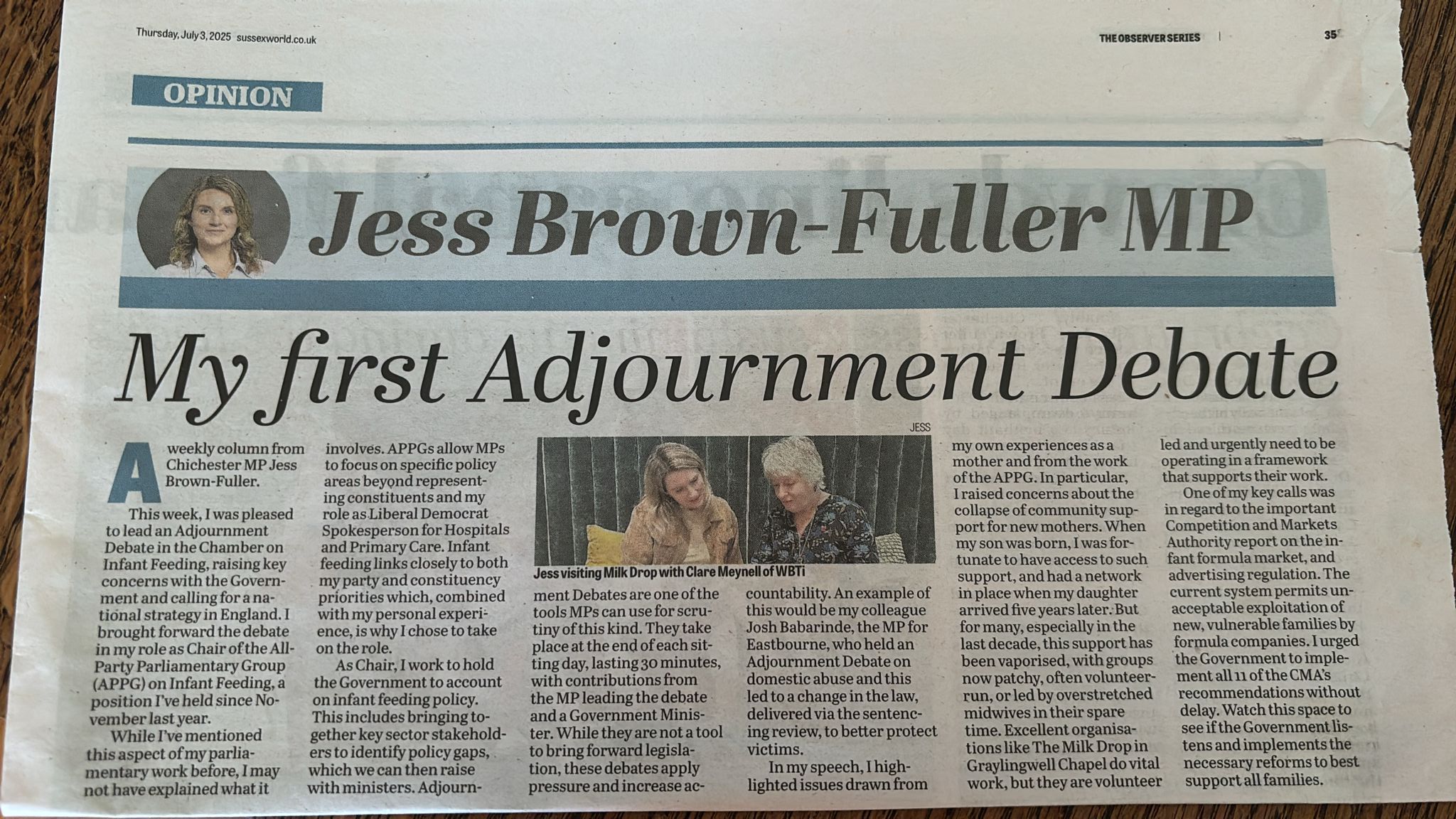
Article in the Sussex Express

Media follow-up

An article in The Independent on 11th August by journalist Abbie Llewellyn followed up on the Adjournment Debate.

Other outlets which picked up on the WBTi Report launch and the debate:

ITV Regional News interviewed Jess Brown-Fuller regarding the outcome of the CMA report, (a market study on infant formula and follow-on formula) set to be released on 1st September 2025.

The i Paper ran an article by journalist Emma Morgan on infant formula marketing.

Parliament News magazine ran a piece by Jess Brown-Fuller MP: Building the ‘healthiest generation ever’ starts with making sure every child has a fair start in life.

The Nursing Times published an article about the WBTi Report launch and policy event, hosted by Jess Brown Fuller, highlighting quotes from iHV CEO Alison Morton, Vicky Sibson of First Steps Nutrition Trust, and Jess Brown-Fuller.

The British Medical Journal on 26 June included a further news article by Gareth Iacobucci, about the WBTi launch and our Call to Action for the government to implement the CMA recommendations in full: “Formula milk: Overpriced and misleading products are risking child health, say campaigners.” BMJ 2025; 389:r1333.

Other recent relevant contributions by Jess Brown-Fuller MP to Parliamentary debates 

Prior to the Adjournment debate on 1st July there was a Parental Leave Review debate led by Justin Madders MP, the Parliamentary Under-Secretary of State for Business and Trade. Various members of the APPG on Infant Feeding attended the meeting. Jess Brown-Fuller asked about the impact of breastfeeding policies on mothers returning to work. Despite the WBTi findings that mothers are struggling with continuing to breastfeed upon return to work, Justin Madders explained that this fell slightly outside the scope of the review but he was happy to correspond on the matter.

On 7th July there was a debate on Giving Every Child the Best Start in Life Strategy, led by Bridget Phillipson MP, Secretary of State for Education. Jess Brown-Fuller asked for confirmation that Best Start centres will be firmly rooted in evidence-based feeding support. The Secretary of State gave an assurance. 

Photo credit: Office of Jess Brown-Fuller MP

Jess Brown-Fuller MP looking at the WBTi Report with Clare Meynell

Author: Clare Meynell RM (rtd), IBCLC

Clare had a long career as a midwife and infant feeding lead achieving the UNICEF UK Baby Friendly Initiative Gold award accreditation at her local hospital. Currently, with Helen Gray, she jointly coordinates the UK WBTI working group and co-presented the first report for the UK in Parliament in November 2016 and the second in 2024.

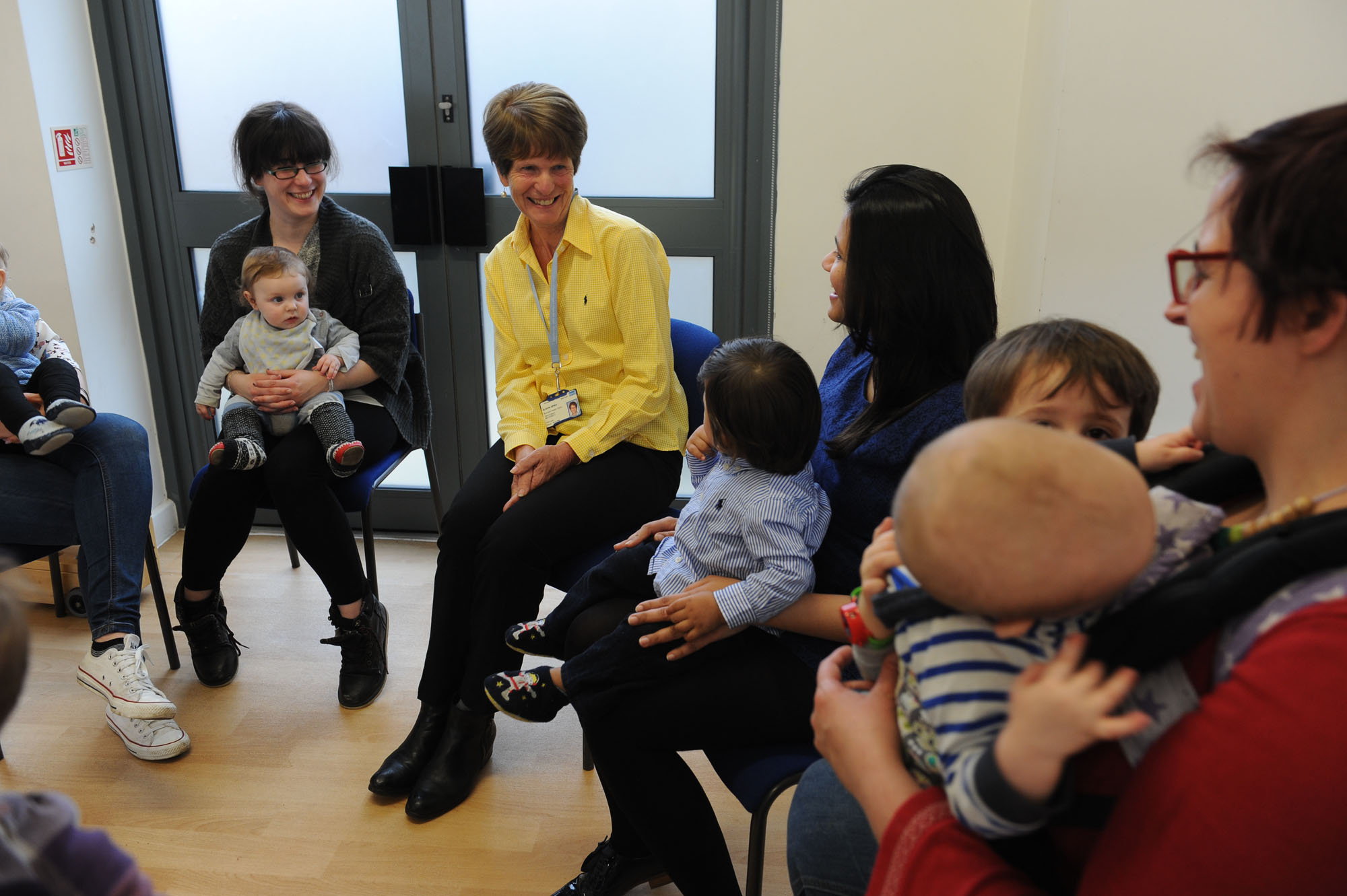
Clare still volunteers her knowledge and experience at a regular mother and baby support group. 

Her focus recently has been to create “Actions for Change” through the WBTi report recommendations so that the next generation of mothers are enabled to achieve their personal breastfeeding goals and that society better understands the health-giving properties of human milk as the physiologically normal first food for babies. 

New WBTi report: first findings

New WBTi report: first findings

Health professional training needs to include more on infant feeding

Gaps in health professional training on infant feeding have been one of the most talked-about findings of the WBTi project in the UK.

The soft launch of the second WBTi Report on UK infant feeding policies and programmes was held at Guy’s Hospital, London, on March 25th, with a focus on gaps in pre-registration training for health professionals.

The WBTi assessment also includes in-service training. In the UK, the main source is UNICEF Baby Friendly Initiative training.

What were the gaps?
Little has changed in these high level universal standards since the 2016 WBTi report. The most striking gap is that the general requirements for all nurses do not explicitly include infant feeding; this means that university health visitor training programs are not required to include much on breastfeeding, unless they are UNICEF Baby Friendly-accredited. Only 21% of university health visitor training programmes are BFI-accredited, although many health visitors will go on to receive in-service training as  69% of health visiting services in the community are now BFI- accredited.  Nurses in other parts of the health system, from emergency rooms to oncology or women’s health, and even in paediatric and neonatal wards, have not routinely received training in breastfeeding.  

Little support for hospitalised mothers

The WBTi team also conducted a survey of infant feeding leads on NHS Trust policies to support hospitalised mothers who are breastfeeding in wards other than maternity, for example to maintain their milk supply. We found that many Trusts lack such a policy. Scotland does have a guideline that has now been rolled out across the NHS in Scotland.

Sharing our findings

The event was well attended by key stakeholders, including representatives from the Department of Health and Social Care and devolved nations, health professional bodies, UNICEF Baby Friendly Initiative, and members of the WBTI Core Group.

The WBTi Steering Group – Helen, Clare, Alison and Patricia

Dr Bob Boyle of Imperial College set the scene with an historical background of infant feeding in the UK and globally. The WBTi team gave an overview of the report, emphasising the importance of every mother in the UK having access to an integrated network of infant feeding support, and the essential need for political commitment to enable this.

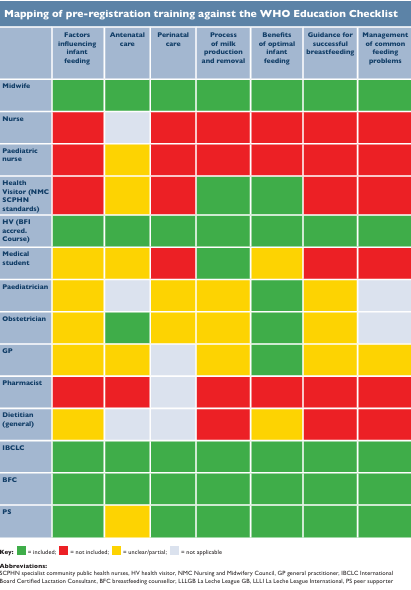
Mapping of pre-registration training standards against the WHO Education Checklist

The UK WBTI assessment maps national minimum standards for training on infant feeding topics against the Educational Checklist from WHO.

The WBTI mapping shows what any family, in any part of the UK, can expect as a minimum from their local health professionals, including not only midwives and health visitors, but also GPs, paediatricians, dietitians and pharmacists. 

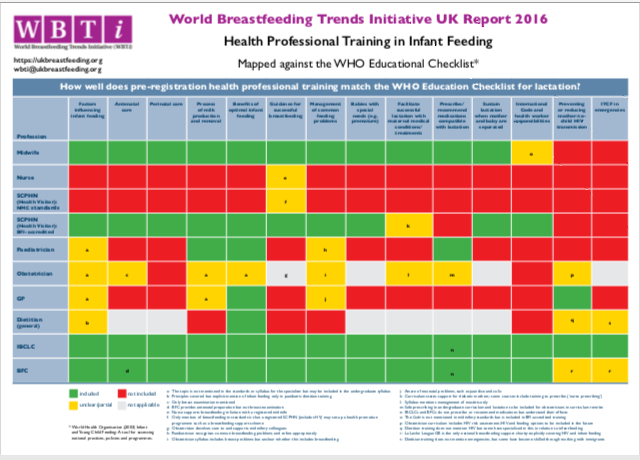
The assessment found some improvements, but many gaps remain, as can be seen in the chart below, with the red indicating the gaps. It is essential that everyone caring for parents have knowledge of breastfeeding. Health workers should be able to support parents’ goals, and avoid inadvertently undermining their infant feeding decisions. 

WBTi summary table of breastfeeding topics in health professional standards

Table of basic standards in breastfeeding topics. More details can be found in Indicator 5 in the full report (Part 1). See Part 2 for a more detailed breakdown.

Author

Dr Alison Spiro is a member of the WBTi Steering Group. She is a retired NCT breastfeeding counsellor, specialist health visitor and hospital and community infant feeding lead, taking both trusts to Baby Friendly accreditation. She completed her MSc in 1994 and PhD in 2004 on Gujarati culture and breastfeeding, doing her fieldwork in Harrow and India. 

Alison is the author of a book ‘Breastfeeding for Public Health, a guide for community health professionals’ published by Routledge. 

The Baby Friendly Initiative – a Global Building Block to Support Breastfeeding #WBW2022

The Baby Friendly Initiative – a Global Building Block to Support Breastfeeding #WBW2022

WHO and UNICEF launched the Baby Friendly Initiative (BFHI) over thirty years ago; three years later, UNICEF UK Baby Friendly Initiative (BFI) was born. The original BFHI framework of Ten Steps was created to improve maternity and hospital practices that undermined breastfeeding, such as separating mothers and their newborns or routine formula supplements, as well as implementing the International Code of Breastmilk Substitutes in maternity settings, in order to eliminate conflicts of interest with the baby feeding industry (companies that manufacture or distribute infant formula/milks, baby foods, feeding bottles and teats) such as promotion of formula milk in healthcare settings, or direct contact by companies with parents.

The Baby Friendly Initiative has changed the face of maternity practices and midwifery training in the UK – breastfeeding initiation has gone up about 20% since UNICEF UK BFI was founded in 1994. In this country, BFI has grown beyond maternity settings to create standards for infant feeding support programmes in the community and for universities training the next generation of midwives and health visitors. The BFI standards were revised in 2012, based upon the twin pillars of breastfeeding and the UN Convention on the Rights of the Child.

BFI standards in the community call for the integration of several levels of breastfeeding care:

  • Routine care: all staff in the universal services (midwives, health visitors, support workers etc) are trained to BFI standard with sound, evidence-based, basic training in supporting breastfeeding and responsive infant feeding. 
  • Additional services: every area should have additional support available, such as trained, skilled peer supporters who can act as an “informed friend” for new mothers, and a network of local peer support groups where new parents can find social support alongside help with everyday breastfeeding issues.
  • Specialist services: every area should also have a referral pathway for specialist care for more complex breastfeeding problems; breastfeeding specialists should have extensive experience or training such as the IBCLC qualification or a recognised breastfeeding counsellor/supporter credential, and either be a registered health professional themselves, or co-lead the specialist service with a registered health professional.
WBTi poster on Integrated Services to Support Breastfeeding, 2019

A good example of how the BFI community standards work is Harrow. Read more HERE about how WBTi UK Steering Team member and specialist health visitor Alison Spiro led Harrow’s local community health services through BFI accreditation, to develop a well integrated services and become 

the only local authority in the UK where breastfeeding was the ‘normal’ way to feed babies”

UNICEF assessment

More recently, UNICEF UK BFI have produced Learning Outcomes for a wider range of health professions: medical students, paediatricians, pharmacists, paediatric/ children’s nurses, maternity support workers and nursery nurses. These will help to address the gaps in high level health professional training standards found in WBTI’s 2016 report. Every health professional who works with women, infants and children should understand the basics of lactation and breastfeeding management, prescribing during lactation, and how to refer parents on to local breastfeeding support.

#WBW2022 Webinar

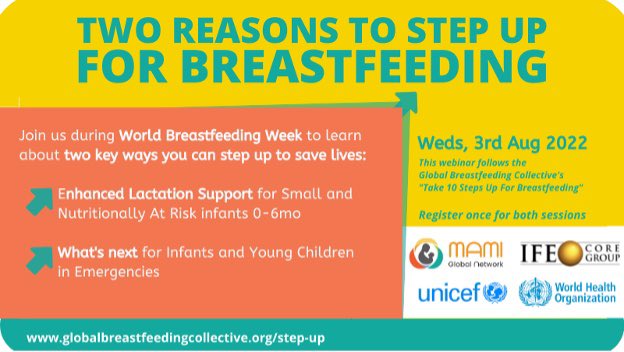
On Wednesday 3 August, we will all have the chance to learn more about the Ten Steps of BFHI in a webinar produced by the Global Breastfeeding Collective, an alliance of NGOs from around the world led by WHO and UNICEF.

In addition, there will be sessions on the care of young breastfed infants who are small or with faltering growth (the MAMI Pathway) and on infant feeding in emergencies. 

The entire webinar runs from 7-9 AM BST and again from 4-6 PM BST, and will be recorded.

Register HERE

Our WBTi #WBW2022 blog will cover these additional topics later in the week.

See you there!

This image has an empty alt attribute; its file name is h-gray-2021-dorset.jpeg

Helen Gray MPhil IBCLC is Joint Coordinator of the WBTi UK Steering Group.

Infant Feeding in Emergencies – Resources for supporting families from #Ukraine #IYCFE

Infant Feeding in Emergencies – Resources for supporting families from #Ukraine #IYCFE

Our WBTi work has revealed that in the UK we have no national guidance on the support and feeding of infants and young children, or pregnant or breastfeeding mothers, during emergencies. There is currently a postcode lottery of Local Resilience Forums who include a few details in their advice to the public such as “Remember to pack formula and nappies for your baby”, but there is no national guidance for LRFs and local authorities that they should include infants and young children in their planning.

This page will serve as a repository for resources for those planning services and those providing feeding support for Ukrainian families with infants and young children.

Breastfeeding provides infants with food security, immune protection, and emotional comfort during disasters.
Basic priorities in an emergency:

1) Support new mothers to hold their babies skin to skin and begin breastfeeding within the first hour.

2) Support mothers who are breastfeeding, partially or fully breastfeeding, to continue breastfeeding and increase their milk supply if needed: provide access to skilled feeding support.

3) Protect infants who are not breastfed: Trained infant feeding / nutrition support teams from trusted NGOs like UNICEF will provide access to safe supplies of appropriate infant formula for babies that need it, and support with safe preparation under hazardous conditions.

4) Protect all infants: breastmilk substitutes and feeding equipment (infant formulas and other milks, bottles, teats, breast pumps and also donor human milk) will be provided by trusted NGOs like UNICEF; the public should AVOID sending donations of these into high risk settings, but send donations of funds to trusted NGOS instead. This will enable them to provide families with what is needed on the ground.

These organisations are members of the Infant Feeding in Emergencies Core Group and have created the international Operational Guidance on Infant Feeding in Emergencies. Please consider supporting their work with families with infants and young children.

We have collected links to infant feeding resources in Ukrainian, and also in the languages of countries housing refugee families, for breastfeeding helpers and aid workers in those countries.

Please send us any suggestions for additional resources

We have a few other resources not included here; please email us any enquiries.

NOTE: we will continue to add links and resources to this page, and these organisations are continuing to add further translations into more languages – please make sure that you clear your cache, or ‘refresh’ the page, each time you open any of these links to ensure that you find the most up to date page.

NOTE: We are providing these resources as a public service, but we cannot read the resources in other languages ourselves, so we cannot always vouch for the accuracy of the contents. Please have someone fluent in the language read it for you.

CONTACT: wbti@ukbreastfeeding.org

WHERE TO START? Watch this 4 minute introductory video from Save the Children

Aid worker or emergency planner? Short video here: how can you incorporate best practice into your support for Ukrainian families?

GET INFORMED: Read the first 25 pages of the Guidance for an overview of best practice.

Resources from the Global Breastfeeding Collective, led by WHO and UNICEF

It is important to continue breastfeeding if you are COVID positive: your milk can pass antibodies to your baby! More resources HERE.

UNICEF UK Baby Friendly resources

Guidance for local authorities on infant feeding during COVID19 (from BFI, First Steps Nutrition Trust, and NIFN). First line guidance for UK local authorities responsible for supporting families

The provision of formula in food banks (November 2020)

Statement on infant formula in food banks (November 2020) – signposting

See also the response to Question 11 on formula donations and distribution in their FAQ here

International humanitarian guidelines and operational guidance

Sphere Handbook

Operational Guidance on Infant feeding in Emergencies
for Emergency Relief Staff and Programme Managers

Available in numerous languages

Media Guide and Guide on writing/ talking about infant feeding in emergencies
These are extremely useful for humanitarian aid organisations and for the media in framing the situation

Guidance for helpers not trained in supporting infant feeding

This short leaflet was written for local authorities and those supporting Afghan refugee families but could be useful for those supporting Ukrainian refugees in the UK. It sets the context, lists some useful resources for parents, provides information about making up powdered infant formula correctly and describes useful actions in some possible scenarios.

Infant feeding support resources – multiple languages

Rapid Feeding Assessment Key Phrases in multiple languages (including Ukrainian, Russian, Romanian, Polish and English – scroll down the page)

Simple Points for Helpers – infant feeding in emergencies in multiple languages (including Ukrainian, Russian, Romanian, Polish and English – scroll down the page)


Pictorial counselling cards in many languages including Russian, adapted to include COVID19 recommendations. Some are full pictorial sets, while some are simply the translation matrix.

Infant Feeding flyer for families in transit (including English, Ukrainian, Polish, Russian, updated for COVID19). Developed by the volunteer team from Infant Feeding Support for Refugee Children/ Safely Fed

Posters and booklets in Ukrainian hosted by the Lithuanian IBCLC Association

Pictorial book about breastfeeding (no words) from La Leche League Netherlands. The PDF is free to use for all. Printing and sharing is allowed, as long as the original file (including credits) is unaltered. Price listed on website is for printed version.

Breastfeeding resources in multiple languages including Ukrainian, Romanian, Russian. (From the Missouri Department of Health and Senior Services, USA)

Breastfeeding Matters – A Guide to Breastfeeding for Women and their Families (from best Start, Ontario Canada) can be downloaded free in Russian and other languages

Translations of key phrases, breastfeeding infographics in many languages, and more: Safely Fed European resources

La Leche League International: Variety of resources and infographics in infant feeding in emergencies translated into multiple languages – most are directed at mothers and parents

Global Health Media: Videos on childbirth and breastfeeding topics.

Infant Feeding in Emergencies Social Media resources:

Infant Feeding Support for Refugee Children Facebook Page: Memes/ graphics in multiple languages, with appropriate captions

La Leche League International Facebook page: Memes/ graphics in multiple languages, aimed at mothers and parents

Safely Fed UK Facebook page – volunteers welcome to create graphics in Canva and to monitor the page! Contact WBTi UK: wbti@ukbreastfeeding.org

For policy makers, emergency planners, media and humanitarian aid workers

Policy resources, media guide, training materials: Infant Feeding in Emergencies Core Group

IYCFE Hub: global hub of resources

Background information on breastfeeding in Ukraine: WBTi 2015 Ukraine Assessment Report

Policy resources, translations of key phrases, and more: Safely Fed European resources

Please do contact us if you are interested in volunteering or have some useful resources to share!!

CONTACT: wbti@ukbreastfeeding.org

Helen Gray MPhil IBCLC is Joint Coordinator of the WBTI UK Steering Team, and Policy and Advocacy Lead at Lactation Consultants of Great Britain. Her research interests include human rights and infant and young child feeding in emergencies.

Infant Feeding in Emergencies – Resources for supporting #Afghan families #IYCFE

Infant Feeding in Emergencies – Resources for supporting #Afghan families #IYCFE

Our WBTi work has revealed that in the UK we have no national guidance on the support and feeding of infants and young children, or pregnant or breastfeeding mothers, during emergencies. There is currently a postcode lottery of Local Resilience Forums who include a few details in their advice to the public such as “Remember to pack formula and nappies for your baby”, but there is no national guidance for LRFs and local authorities that they should include infants and young children in their planning.

This page will serve as a repository for resources for those planning services and those providing feeding support for families in crisis in the UK.

Currently there are many gaps in the support for families who have been evacuated from Afghanistan, so resources in Afghan languages are collected here.

Please send us any suggestions for additional resources

We have a few other resources not included here, including Rapid Assessment Tools and Simple Phrases about feeding, and a Peer Counsellor Training Curriculum in Dari; please email us any enquiries.

CONTACT: wbti@ukbreastfeeding.org

NOTE: We are providing these resources as a public service, but we cannot read the resources in other languages ourselves, so we cannot always vouch for the accuracy of the contents. Please have someone fluent in the language read it for you.

UNICEF UK Baby Friendly resources

Guidance on infant feeding during COVID19 (from BFI, First Steps Nutrition Trust, and NIFN)

First line guidance for local authorities responsible for supporting families

The provision of formula in food banks (November 2020)

Statement on infant formula in food banks (November 2020) – signposting

See also the response to Question 11 on formula donations and distribution in their FAQ here

International humanitarian guidelines and operational guidance

Sphere Handbook

Operational Guidance on Infant feeding in Emergencies
Operational Guidance for Emergency Relief Staff and Programme Managers
Available in numerous languages

Guides on writing/ talking about infant feeding in emergencies and Media Guide
These are extremely useful in framing the situation

Guidance for helpers not trained in supporting infant feeding

This short leaflet sets the context, lists some useful resources for parents, provides information about making up powdered infant formula correctly and describes useful actions in some possible scenarios.

Infant feeding resources – multiple languages

Rapid Assessment tools in various languages – contact wbti@ukbreastfeeding.org

Infant Feeding Counselling resources
Pictorial counselling cards in many languages, adapted to include COVID19 recomendations

Infant Feeding flyer for families in transit (English, Arabic, Farsi, Kurdish)

Developed by the volunteer team from Infant Feeding Support for Refugee Children/ Safely Fed

Email us for more languages

Pictorial book about breastfeeding (no words) from La Leche League Netherlands

The PDF is free to use for all. Printing and sharing is allowed, as long as the original file (including credits) is unaltered. Price listed on website is for printed version.

Breastfeeding resources in multiple languages (Missouri Department of Health and Senior Services, USA)

Infant Feeding in Emergencies Social Media resources:

Support for Refugee Children Facebook Page
Memes/ graphics in multiple languages, with appropriate captions

Safely Fed UK Facebook page – volunteers welcome to create graphics in Canva and to monitor the page! Contact WBTi UK: wbti@ukbreastfeeding.org

Resources in Afghan languages: Dari and Farsi

Background information on breastfeeding in Afghanistan: WBTi 2019 report on Afghanistan

Pictorial counselling cards for Afghanistan, in Dari

Infant Feeding flyer for families in transit: versions in Farsi and English

Developed by the volunteer team from Infant Feeding Support for Refugee Children/ Safely Fed

Breastfeeding Confidence booklet by the Australian Breastfeeding Association, in Dari

Video from UNICEF in Dari

Breastfeeding Matters – An Important Guide to Breastfeeding for Women and their Families (from best Start, Ontario Canada) can be downloaded free in Farsi

Breastfeeding information in Farsi and other languages (Missouri Department of Health and Senior Services, USA)

Please do contact us if you are interested in volunteering or have some useful resources to share!!

CONTACT: wbti@ukbreastfeeding.org

Helen Gray MPhil IBCLC is Joint Coordinator of the WBTI UK Steering Team, and Policy and Advocacy Lead at Lactation Consultants of Great Britain. Her research interests include human rights and infant and young child feeding in emergencies.

#WBW2021 Protect Breastfeeding: A Shared Responsibility – Communities

#WBW2021 Protect Breastfeeding: A Shared Responsibility – Communities

‘Creating breastfeeding Communities’.

The Harrow Example.

How can communities change to give parents consistent support with breastfeeding?

Our Harrow model of integrated working across hospital and community services showed that when professionals, lay supporters and specialists worked effectively together under a shared strategy and infant feeding policy, that more parents felt supported to breastfeed their babies.   Over two years higher breastfeeding initiation, continuation and exclusivity rates were beginning to be reported.   Parents found that they experienced less conflicting advice and breastfeeding gradually began to be seen as the normal way to feed babies in Harrow.

This was achieved through joint training sessions involving community and hospital staff.  Midwives, midwifery managers, paediatricians, neonatal nurses, paediatric nurses, A&E nurses, health visitors, peer supporters and breastfeeding counsellors all attended the same sessions.  Through these, they were able to understand each other’s roles and responsibilities and plan care together.  

Peer supporters helped to run daily community drop-in groups with health visitors, and some worked in the antenatal clinic and postnatal wards of the hospital.   Specialist, targeted peer support was offered to teenage parents, those with multiples and Somali mothers.  A copy of Best Beginning’s ‘Bump to Breastfeeding’ DVD was given to all antenatal parents, who were also invited to a popular Saturday morning breastfeeding workshop.

Over a period of ten years, mothers felt comfortable breastfeeding their babies all over the borough and became visible in shopping centres, cafes, supermarkets, parks, and school grounds.  

The National Maternity Review reported in 2016:

‘In Harrow, a multi-ethnic London borough with high infant mortality rates, and areas of deprivation and poverty, the Director of Public Health identified breastfeeding as a top priority for 2006. A multi-professional approach was adopted with Harrow Community Health Services working with the local hospital to improve breastfeeding rates. UNICEF Baby Friendly training was commissioned for midwives, health visitors and support staff in 2007. A peer support training programme began and mothers were recruited from a local support group. A network of breastfeeding support groups was established running from children’s centres, eventually achieving one every day within walking distance for all mothers. In 2008, Bump to Breastfeeding DVDs were given to every pregnant woman by midwives, health visitors and peer supporters. Harrow became accredited as Baby Friendly in 2012 and the local hospital gained the award in 2013. The staff training, peer support programme and free DVDs increased breastfeeding rates, so by 2010 initiation rates had risen to 82% and 6-8 weeks to 73%. By 2013, Harrow had 87% of mothers initiating and 75% breastfeeding at 6-8 weeks (50% exclusively), with one of the lowest drop-off rates in the UK. UNICEF assessed Harrow for its re-accreditation in 2014 and stated that it was the only local authority in the UK where breastfeeding was the ‘normal’ way to feed babies’.[1]

Other examples of Integrated community breastfeeding support:

https://www.wearebesideyou.co.uk/Swindon

Harrow was featured in the UK WBTi report in 2016, as an example of good practice

Email us at wbti@ukbreastfeeding.org

Sign up to our mailing list HERE


Dr Alison Spiro -Specialist health visitor (rtd) is a member of the WBTi UK Steering Group.


[1] ‘national-maternity-review-report.pdf’ (2016). Available at: https://www.england.nhs.uk/wp-content/uploads/2016/02/national-maternity-review-report.pdf

#WBW2021 Protect Breastfeeding: A Shared Responsibility – Peer Support

#WBW2021  Protect Breastfeeding: A Shared Responsibility – Peer Support

A network of trained peer support is an essential part of high quality integrated breastfeeding services.

Unicef UK Baby Friendly Initiative (BFI) outlines three components that good local breastfeeding services must include, in order to be awarded Baby Friendly accredited status.

Basic, or Routine Care

All health workers who work with new families (health visitors and any allied healthcare assistants in the community services) have been trained to BFI standard (approximately 18 hours of initial in service training, with yearly updates of an hour or more).

Additional services

Here BFI outlines how every health visiting and community service must be embedded in and well supported by a network of trained peer supporters, or other social and trained breastfeeding support. NICE recommends that peer support programmes be externally accredited. Good practice includes not only training, but also regular supervision and updates of skills and knowledge. Typical peer support programmes require peer supporters to be experienced breastfeeding mothers, and often expects them to come from similar communities as the population they are supporting. Training generally is part time, over 16-36 hours. Peer supporters work in a supervised setting, acting as an “informed friend,” and referring complex cases on to health professionals or an advanced breastfeeding practitioner such as an IBCLC or breastfeeding counsellor, using a referral pathway.

Breastfeeding counsellors in the UK are also experienced breastfeeding mothers, so they also provide a type of peer support, or “mother-to-mother” support. Their training typically take around two years, and they are autonomous practitioners, who can be responsible for leading their own local breastfeeding support groups, usually through one of the main UK breastfeeding voluntary organisations.

Mothers who are experiencing breastfeeding challenges often need more than one visit – and they need the time that it requires for skilled listening as well as exploration of possible breastfeeding strategies to resolve the issue. Although many health visitors have additional breastfeeding training and skills, the health visitor workforce is vastly overstretched, and it simply isn’t possible to provide the time and the number of visits that many breastfeeding mothers need.

But peer support programmes can provide this – they offer groups where lonely mothers can meet others and gain confidence in their own mothering, alongside skilled listening and well- informed support. Many mothers will find their own “village” in their local breastfeeding support group, and will return again and again. Some will go on to train as peer supporters or breastfeeding counsellors themselves.

Peer support groups are the beating heart of breastfeeding support

Helen Gray, WBTi Joint Coordinator
WBTi audit of peer support and breastfeeding counsellors provided by the voluntary sector, 2016
In Part 2 of our WBTi UK Report

Specialist support

Every area should have a referral pathway to specialist care at the IBCLC (International Board Certified Lactation Consultant) or similar level, for those complex cases where breastfeeding issues cannot be resolved at the level of basic/ routine care or by additional peer support.

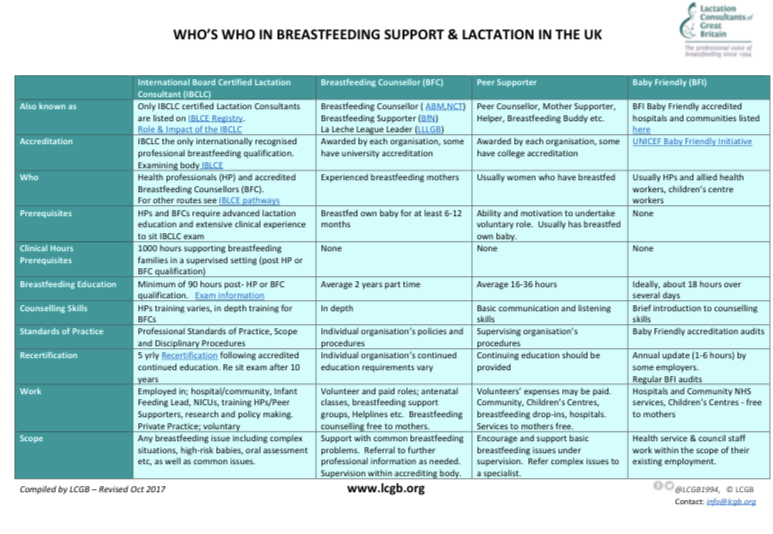
The different roles of breastfeeding support in the UK have been outlined in the chart below:

Who’s Who in Breastfeeding Support and Lactation in the UK, from Lactation Consultants of Great Britain

WBTi’s research: Case studies of best practice
The WBTi 2016 Report featured several case studies of areas who showed best practice in providing well joined up, integrated breastfeeding services: Brighton and Harrow.

Case studies of two breastfeeding services providing integrated support, 2016.
In Part 2 of our WBTi UK Report

More recently, our WBTi team has presented posters featuring these and additional case studies of best practices in providing integrated breastfeeding services: Medway, Harrow and Swindon.

WBTi Poster on Integrated Breastfeeding Services.

These examples of best practice in integrated breastfeeding services gave concrete results.

They demonstrated:

– a 2% rise in breastfeeding rates in a socially deprived area in 2018 (Medway),

– a 15% rise in initiation and a 12% rise in continuation of breastfeeding over a six year period (Harrow)

– and a 6% reduction in drop off rates from birth to 6-8 weeks over six years (Swindon).

Our WBTi team are always on the lookout for further examples of best practice in integrated breastfeeding services, and we submit them to Public Health England. Please do contact us if you would like to submit your local services!

Email us at wbti@ukbreastfeeding.org

Sign up to our mailing list HERE

Banner photo credit: Pixabay

Helen Gray MPhil IBCLC is Joint Coordinator of the World Breastfeeding Trends (WBTi) UK Working Group. She is also an accredited Leader (breastfeeding counsellor) with La Leche League of Great Britain.

#WBW2021 Protect Breastfeeding: A Shared Responsibility – Fathers

#WBW2021  Protect Breastfeeding: A Shared Responsibility – Fathers

For Day 2 of WBW we are very pleased to have a guest blog by Health Visitor and Clinical Research Fellow Dr. Sharin Baldwin.

Breast milk provides the ideal nutrition for infants and its associated benefits to the infant, mother and the wider public health are well documented. Traditionally breastfeeding promotion and advice have been targeted at expectant and new mothers, with an aim to increasing breastfeeding rates in infants. In recent years it has been acknowledged that partners play an important role in supporting women’s decision to breastfeed, while also providing practical and emotional support with the continuation of breastfeeding. Research highlights the important role of fathers in promoting and supporting their partners with breastfeeding (Tohotoa et al., 2011; Datta et al., 2012; Sherriff et al., 2014; Hansen et al., 2018), but in practice fathers continue to report inadequate levels of information and support from health professionals. Training for health professionals therefore should consider men’s needs relating to breastfeeding promotion and support, as well as women’s.

New fathers have often reported finding their partner’s breastfeeding experiences to be much more difficult than they had originally anticipated, with many not knowing how to help or support their partner with breastfeeding when they experienced difficulties (Baldwin et al, 2018; 2019). This is where health professionals can really make a difference. They can help educate and prepare expectant fathers better during the antenatal period by providing them with ‘realistic’ information about the time it may take for their partner to establish breastfeeding. It is also important to highlight some of the breastfeeding challenges they may face in early parenthood and what strategies or support are available to overcome them. This will help men to develop more realistic expectations of the processes involved with establishing breastfeeding and make them feel more empowered to support their partner when faced with any difficulties.
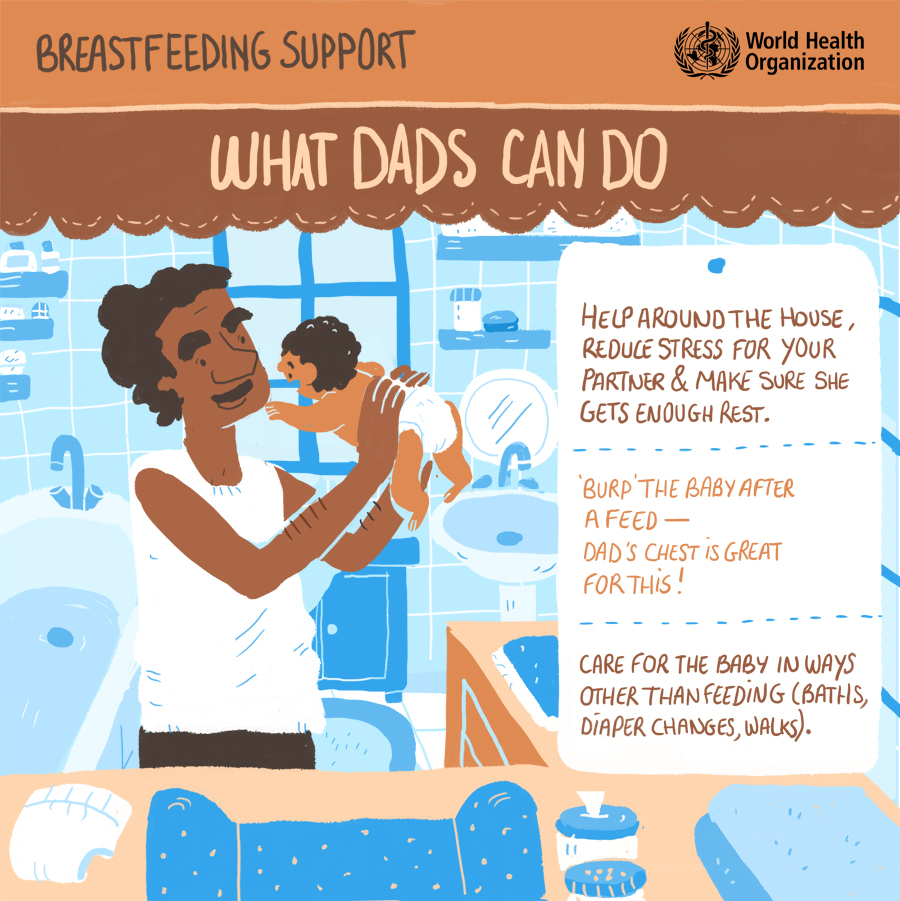
While fathers may not be able to be directly breastfeed their babies, they need to know that they play a crucial role in making breastfeeding a success. They can provide practical support to their partners through helping with household duties, giving them a massage, allowing them to rest, making meals and drinks for them, and giving them emotional support through regular praise, reassurance and encouragement. Good levels of breastfeeding support are likely to make the process easier and more enjoyable, while giving women the confidence to continue breastfeeding for longer. Fathers’ involvement in breastfeeding not only has the potential to increase breastfeeding rates and duration, but also contribute to better outcomes for babies, mothers and the wider public health agenda. So, let’s not forget about including fathers when having those crucial discussions and training about breastfeeding!

World Health Organization

Sign up to our WBTi UK mailing list HERE

References:

Baldwin, S., Malone, M., Sandall, J., Bick, D. (2018) Mental health and wellbeing during the transition to fatherhood: a systematic review of first-time fathers’ experiences. JBI Database of Systematic Reviews and Implementation reports, 16(11):2118–91.
Baldwin, S., Malone, M., Sandall, J., Bick, D. (2019) A qualitative exploratory study of UK first-time fathers’ experiences, mental health and wellbeing needs during their transition to fatherhood. BMJ Open 2019;9:e030792. doi:10.1136/bmjopen-2019-030792 https://bmjopen.bmj.com/content/9/9/e030792.info

Datta, J., Graham, B., Wellings, K. (2012) The role of fathers in breastfeeding: decision-making and support. British Journal of Midwifery, 20(3):159–167.

Hansen, E., Tesch, L., Ayton, J. (2018) ‘They’re born to get breastfed’- how fathers view breastfeeding: a mixed method study. BMC Pregnancy and Childbirth, 18:238 https://doi.org/10.1186/s12884-018-1827-9

Sherriff, N., Hall, V., Panton, C. (2014) Engaging and supporting fathers to promote breast feeding: A concept analysis. Midwifery, 30: 667–677.

Tohotoa, J., Maycock, B., Hauck, Y.L., Howat, P., Burns, S., Binns, C.W. (2009) Dads make a difference: an exploratory study of paternal support for breastfeeding in Perth, Western Australia. International Breastfeeding Journal, 4: 15. http://dx.doi.org/10.1186/1746-4358-4-15

Author:

Dr. Sharin Baldwin PhD, MSc, PG Dip, BSc (Hons), HV, RM, RN, QN, FiHV, IHV Research & PIMH Champion

NIHR Clinical Research Fellow, University of Warwick

Clinical Academic Lead (Nursing and Midwifery), London North West University Healthcare Trust

#WBW2021 Protect Breastfeeding: a Shared Responsibility – Health Professionals

#WBW2021  Protect Breastfeeding: a Shared Responsibility – Health Professionals

This is the start of World Breastfeeding Week, which runs from the 1st to the 7th August each year. Our focus this year for Day 1 is Health Professionals.

“It takes a village to raise a child; it takes a community to support mothers to breastfeed

Sue Ashmore, Unicef UK Baby Friendly Initiative

Sue Ashmore of the Unicef UK Baby Friendly Initiative (BFI) wrote in 2017 ‘Just as the saying goes: ‘It takes a village to raise a child’, it takes a community to support mothers to breastfeed.’ (blog for the Huffington Post). That community includes health professionals but also breastfeeding specialists, such as IBCLCs and breastfeeding counsellors, and trained peer supporters.

Health professionals who have contact with mothers and their babies are a crucial part of that village of support. Since the WBTi report was pubished in 2016, an improvement has been the requirement of the NHS England Long-Term Plan (p.49) that all maternity units work towards achieving Baby Friendly accreditation. In comparison, all Scotland and N.I. maternity units were already accredited by 2016. Meeting this requirement will help provide a good basic standard of infant feeding support in English maternity units but as yet there is no requirement for neonatal units or community services (primarily that means the health visiting service) to achieve Baby Friendly status.

Summary table mapping UK health professional standards against WHO Educational Checklist on Infant and Young Child Feeding. See our report part 1 (for the table) and Part 2 (for details of individual health professions) https://ukbreastfeeding.org/wbtiuk2016/

The 2016 WBTi report highlighted the need for better training for most health professionals who work with new mothers. Since then, we’re very pleased to report that many more resources have been made available, including:

  • The GP Infant Feeding Network (GPIFN) and Hospital Infant Feeding Network (HIFN) were created and both have highly informative websites.
  • There have been some improvements to the paediatric and GP education curricula.
  • BFI has produced learning outcomes for students of several professions – medical, dietetic, pharmacy and maternity support workers/nursery nurses.
  • The University of Glasgow, working with BFI, has developed an e-learning module for first year medical students to support meeting the learning outcomes.
  • The Royal College of Paediatrics and Child Health has regularly updated its position statement on breastfeeding, the latest being June 2021, and includes: ‘RCPCH strongly supports breastfeeding, the promotion of breastfeeding, the provision of advice and support for women, and national policies, practices and legislation that are conducive to breastfeeding. All child health professionals should be trained to deliver simple breastfeeding advice.’
  • The Royal College of General Practitioners launched its position statement on breastfeeding in 2017 and then a free e-learning course on breastfeeding in 2018.
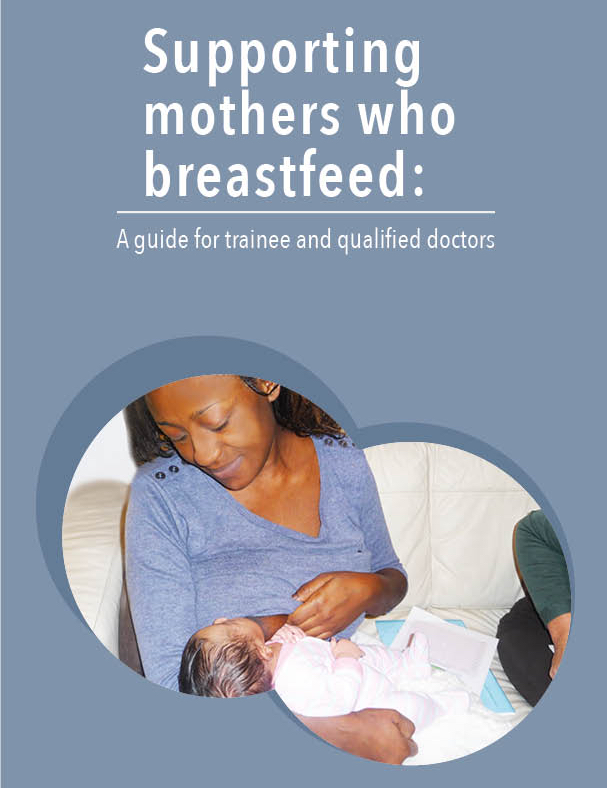
  • An e-book for trainee doctors that I wrote, available on our website.
Free e-book on breastfeeding for doctors, by Patricia Wise
https://ukbreastfeeding.org/supporting-mothers-who-breastfeed-a-guide-for-trainee-and-qualified-doctors/

Thus some progress has been made towards the vision of all mothers who want to breastfeed being able to access seamless support from health professionals, additional breastfeeding specialists and trained peer supporters, all of whom value breastfeeding and are knowledgeable enough either to provide evidence-based information and support themselves or signpost to appropriate support.

Subscribe to our mailing list HERE

Patricia Wise is an NCT Breastfeeding Counsellor and a member of the WBTi UK Steering Group

How confident do medical students feel about supporting breastfeeding?

How confident do medical students feel about supporting breastfeeding?

A new study by trainee doctor Kirsty Biggs and senior colleagues has shown that 97% of the 411 medical students who responded to a survey are uncertain of their practical skills to support new mothers with breastfeeding, such as helping with latch issues, although the overall benefits of breastfeeding were moderately well-known. Yet most students (93%) perceived doctors to have an important role in supporting breastfeeding and the same percentage requested further breastfeeding education.

Over 80% of the respondents had a career interest in obstetric and gynaecology, paediatrics and/or general. While the sample was only around 1% of UK medical students, and only one-quarter of the students responding were male, it’s a very clear message that breastfeeding education overall is not adequate. 

Around 80% of the 32 UK medical schools eligible responded to their part of the survey and results indicate that only 70% of medical schools provide compulsory breastfeeding education. 

WBTI’s findings and vision

The WBTi UK report in 2016 indicated that medical curricula have many gaps with regard to breastfeeding, and Biggs’ study confirms that the students themselves find it inadequate. WBTi UK’s vision is that all doctors have sufficient training in infant feeding to protect the decisions of mothers who want to breastfeed.

UK Health Professional training standards mapped against WHO educational checklist. From the WBTI UK report. See also Part 2 for details of individual specialisms

How can the situation be improved? 
High level standards and Unicef BFI learning outcomes

The General Medical Council provides broad guidelines for undergraduate curricula in its Outcomes for Graduates document and each medical school devises its own curriculum to fit the guidelines. For example, the expectation under the Outcomes Health promotion and illness prevention section is: ‘Newly qualified doctors must be able to apply the principles, methods and knowledge of population health and the improvement of health and sustainable healthcare to medical practice’.  Unicef UK Baby Friendly Initiative’s learning outcomes for several professions, including medical students, published in November 2019 are highly relevant to improving curricula and accompanying resources are being developed. 

RCPCH curriculum – an encouraging sign

Medical training is long, with undergraduate, Foundation and then specialty training. The RCPCH (Royal College of Paediatrics and Child Health) states as part of its activity to promote breastfeeding: ‘The RCPCH training curriculum for General Paediatricians and all paediatric subspecialties requires training to understand the importance of breastfeeding and lactation physiology, be able to recognise common breastfeeding problems, have knowledge of formula and complementary feeding, and be able to advise mothers or refer for support.’

Resources available

Qualified doctors also benefit from improving and updating their skills and knowledge. RCGP’s (Royal College of General Practitioners) Breastfeeding Position Statement has a link in the first sentence to its online resource on breastfeeding. 

by Patricia Wise

I’m very pleased that my e-book Supporting Mothers Who Breastfeed: A guide for trainee and qualified doctors, which is particularly aimed at trainers and trainee doctors, has been included in the Postnatal care guidelines of RCGP Learning.

The GP Infant Feeding Network (GPIFN) and Hospital Infant Feeding Network (HIFN) websites contain extensive information for doctors. 

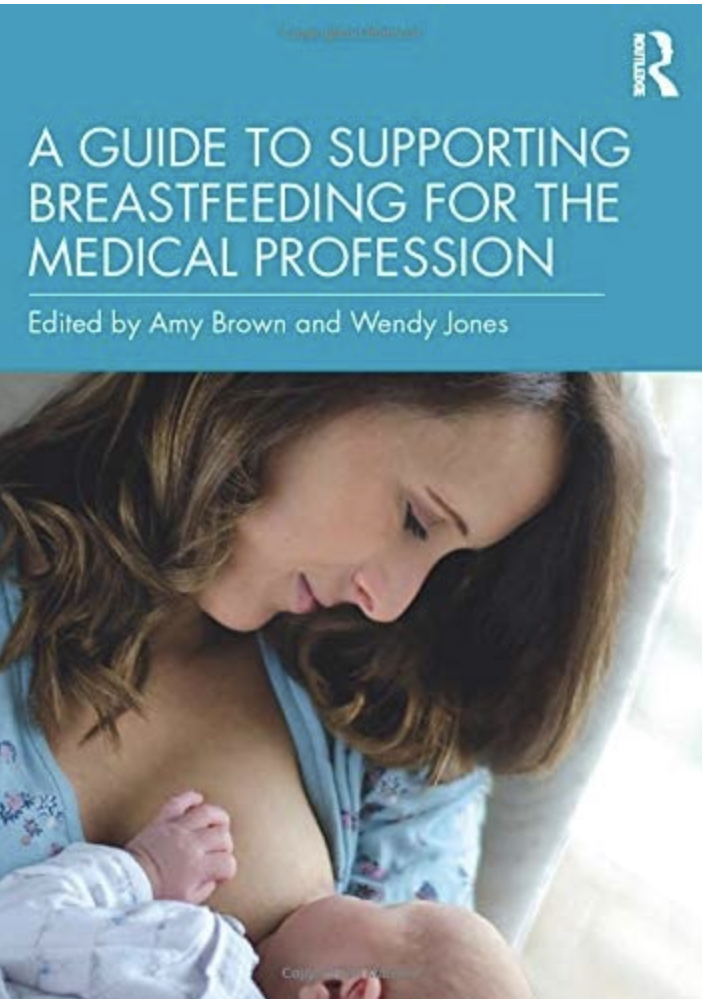
Other resources include Amy Brown and Wendy Jones’ book A guide for the Medical Professionpublished in December 2019.

Guidance to qualified doctors

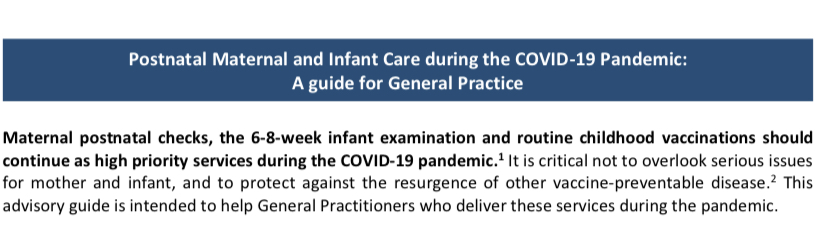
Mentioning infant feeding in guidance to doctors to encourage including it in consultations is also important. GP Louise Santhanam (founder of GPIFN) is the lead author of Postnatal Maternal and  Infant care during the COVID-19 Pandemic: a Guide for General Practice that was recently added to the RCGP website. This clarifies that 6-8 week checks need to continue despite the Covid-19 pandemic and that infant feeding should be a routine clinical consideration.

Postnatal Maternal and Infant Care during COVID-19: A Guide for GPs by Louise Santhanam

The challenge

Thus plenty of resources are available but doctors are busy people. While some really understand the importance of protecting breastfeeding, and know how to  – such as signposting mothers to local skilled help – the challenge is how to bring this into every medical student’s training.

If you know anyone at medical school, it would be really useful if you can let them know about Kirsty Biggs’ study.

Sign up to our WBTI UK Mailing list HERE

Banner photo from Freepic

Patricia Wise is an NCT Breastfeeding Counsellor, a member of the WBTi UK Steering Group, and the author of Supporting Mothers Who Breastfeed: A guide for trainee and qualified doctors