Adjournment debate in UK Parliament on infant feeding

Adjournment debate in UK Parliament on infant feeding

On 1 July, Chichester MP Jess Brown-Fuller led her first adjournment debate in the House of Commons Chamber. 

She raised key concerns with the Government, calling for a national strategy for England. In her role as chair of the All-Party Parliamentary Group (APPG) on Infant Feeding she focuses on specific policy areas, beyond her constituency work. She aims to hold the government to account, by raising identified gaps in policy with the relevant government minister. Such debates apply pressure to increase accountability so may lead to a change in the law. 

Jess highlighted her own positive experience of a network of community support when her children were born a decade ago but which is now, at best, patchy or non-existent. She urged the government to implement all eleven Competition and Markets Authority (CMA) final report recommendations to protect families from the current unacceptable exploitation by the infant formula market.

Several MPs supported the debate by sharing both their own experiences and stories from constituents about the importance of skilled breastfeeding support.

WBTi in Parliament

For the first time, the WBTi report was mentioned by a minister on the floor of the House of Commons. Ashley Dalton, Parliamentary Under-Secretary of State for Public Health and Prevention in the Department of Health and Social Care, replied on behalf of the government:

 “We recognise the concerns raised in the World Breastfeeding Trends Initiative’s United Kingdom report and are considering the recommendations” and “we know through the report that England scores poorly, and we want to change that.” See Column 260 in the Hansard report of the debate.

MPs who attended:

Maya Ellis, Labour MP Ribble Valley

Jim Shannon, DUP MP Strangford ( Northern Ireland ) 

Connor Rand, Labour MP Altrincham and Sale West

Samantha Niblett, Labour MP South Derbyshire

David Reed, Conservative MP Exmouth and Exeter East

David Chadwick, Liberal Democrat MP Brecon Radnor and Cwm Tawe (Wales)

Dr Danny Chamber, Liberal Democrat Winchester
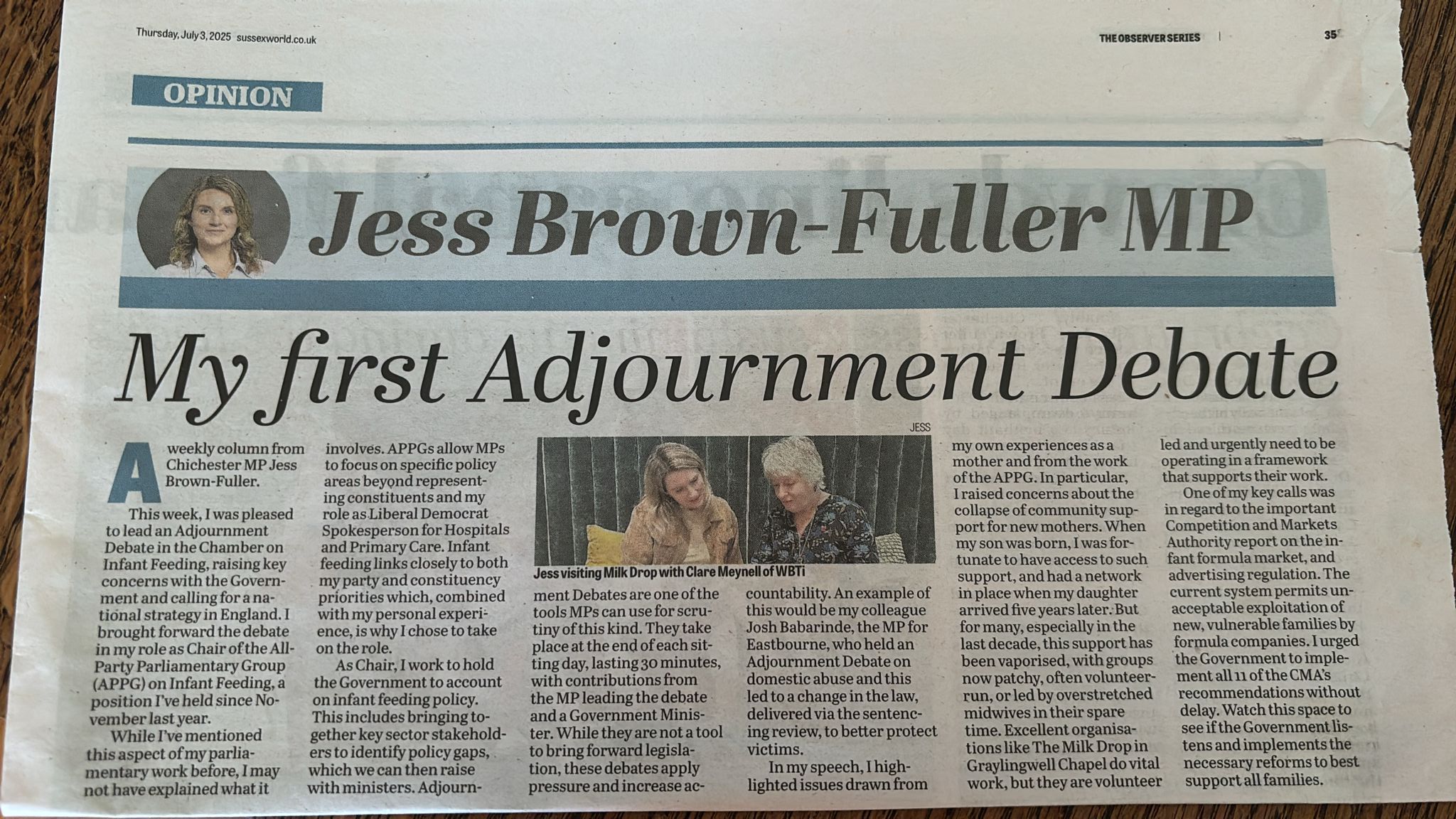
Article in the Sussex Express

Media follow-up

An article in The Independent on 11th August by journalist Abbie Llewellyn followed up on the Adjournment Debate.

Other outlets which picked up on the WBTi Report launch and the debate:

ITV Regional News interviewed Jess Brown-Fuller regarding the outcome of the CMA report, (a market study on infant formula and follow-on formula) set to be released on 1st September 2025.

The i Paper ran an article by journalist Emma Morgan on infant formula marketing.

Parliament News magazine ran a piece by Jess Brown-Fuller MP: Building the ‘healthiest generation ever’ starts with making sure every child has a fair start in life.

The Nursing Times published an article about the WBTi Report launch and policy event, hosted by Jess Brown Fuller, highlighting quotes from iHV CEO Alison Morton, Vicky Sibson of First Steps Nutrition Trust, and Jess Brown-Fuller.

The British Medical Journal on 26 June included a further news article by Gareth Iacobucci, about the WBTi launch and our Call to Action for the government to implement the CMA recommendations in full: “Formula milk: Overpriced and misleading products are risking child health, say campaigners.” BMJ 2025; 389:r1333.

Other recent relevant contributions by Jess Brown-Fuller MP to Parliamentary debates 

Prior to the Adjournment debate on 1st July there was a Parental Leave Review debate led by Justin Madders MP, the Parliamentary Under-Secretary of State for Business and Trade. Various members of the APPG on Infant Feeding attended the meeting. Jess Brown-Fuller asked about the impact of breastfeeding policies on mothers returning to work. Despite the WBTi findings that mothers are struggling with continuing to breastfeed upon return to work, Justin Madders explained that this fell slightly outside the scope of the review but he was happy to correspond on the matter.

On 7th July there was a debate on Giving Every Child the Best Start in Life Strategy, led by Bridget Phillipson MP, Secretary of State for Education. Jess Brown-Fuller asked for confirmation that Best Start centres will be firmly rooted in evidence-based feeding support. The Secretary of State gave an assurance. 

Photo credit: Office of Jess Brown-Fuller MP

Jess Brown-Fuller MP looking at the WBTi Report with Clare Meynell

Author: Clare Meynell RM (rtd), IBCLC

Clare had a long career as a midwife and infant feeding lead achieving the UNICEF UK Baby Friendly Initiative Gold award accreditation at her local hospital. Currently, with Helen Gray, she jointly coordinates the UK WBTI working group and co-presented the first report for the UK in Parliament in November 2016 and the second in 2024.

Clare still volunteers her knowledge and experience at a regular mother and baby support group. 

Her focus recently has been to create “Actions for Change” through the WBTi report recommendations so that the next generation of mothers are enabled to achieve their personal breastfeeding goals and that society better understands the health-giving properties of human milk as the physiologically normal first food for babies. 

New WBTi Report: Parliamentary launch

New WBTi Report: Parliamentary launch

Jess Brown-Fuller, MP for Chichester, hosted the formal launch of the WBTi 2024 UK report on July 24th 2025 in the Jubilee Room at the Houses of Parliament. 

(left to right) Patricia Wise, Clare Meynell, Jess Brown-Fuller MP with visiting baby Niamh, Helen Gray, Alison Spiro

Kate Quilton

Investigative journalist Kate Quilton drew on her own experiences in emphasising the importance of a  policy framework, and chaired the Q&A.

What do policymakers need to do, to protect and support breastfeeding? 

The WBTi 2024 report made a number of key policy recommendations on maternity rights, marketing regulations and food safety.

WBTi’s ‘big ask’

The aim of the WBTi project is to galvanise action to implement report recommendations, thus improving support and protection for infant feeding. Our single most immediate actionable ask is for the UK and devolved governments to adopt the eleven recommendations of the Competition and Markets Authority (CMA) report on regulating misleading infant formula promotion. Adopting these would help to end the profiteering we have seen in recent years (formula prices have gone up by 24%! including one by 49%!). This would also help families make informed infant feeding decisions and for them to be able to access affordable products to feed their babies if needed.

The CMA recommendations encompass many of the WBTi UK recommendations on protecting families from exploitative marketing. In addition, WBTi calls for the regulations to apply to ALL formulas from 0-36 months. This would help end the loopholes that companies use in the marketing of formulas for older babies and toddlers, or for special medical purposes.

Professor Nigel Rollins

Professor Nigel Rollins, who formerly worked for the World Health Organisation and is now at Queens University, Belfast, gave a policy overview and more details about our ‘Call to Action’. 

Parents are struggling

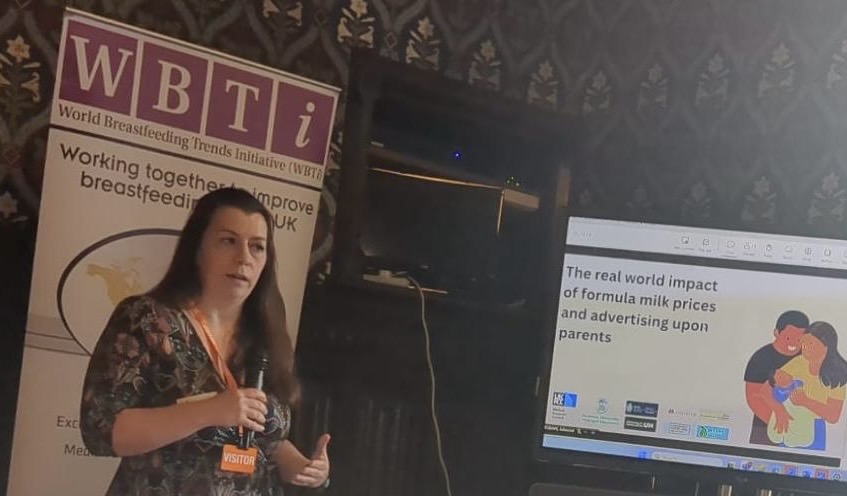
Professor Amy Brown of Swansea university stunned the room when she revealed some of the shocking findings of her research into the challenges families are facing to afford the high prices of formula.

Professor Amy Brown

Her presentation called for:

  • Lower priced milks – consistent, reliable and affordable pricing
  • Accurate information, not adverts
  • Parents should be supported to feed their baby without worrying about cost
  • For the health and well-being of parents and babies to be put before profits

She shared powerful testimony about the impact of the high cost of formula from parents themselves:

Breastfeeding is important

“Breastfeeding is a human right for both mother and child” (UN human rights joint statement 2016).

WBTi work is built on a foundation of human rights. UN human rights experts have made it clear that breastfeeding is a right of the dyad, the mother and infant together. The rights of one don’t supercede the other; mother and baby have rights as a dyad. It is the responsibility of our governments to support and protect those rights, by providing skilled health care, maternity protection at work, and protecting the rights of women and families to make their own informed decisions about how to feed their baby, without commercial influence.

What is the impact of low breastfeeding rates in the UK?

High costs for the NHS:

Low UK breastfeeding rates are costing the NHS £millions:

  • 54,000 more GP appointments
  • 9,500+ additional hospitalisations

Research has shown that basic interventions to support more mothers to breastfeed for longer could pay for themselves within a year. (Renfrew et al 2012)

Costing our planet:

The formula and dairy industries have a significant footprint both of greenhouse gases and water.

“For the UK alone, carbon emission savings gained by supporting mothers to breastfeeding would equate to taking between 50,000 and 77,500 cars off the road each year” (Joffe et al 2019)

Key recommendations from the WBTi Core Group

Our governments must address the ‘baby blind spots’ in national policies:

  • Protect all infants by adopting in full the recommendations of the CMA, and extending the regulations to cover all infant milks up to 3 years, in order to address current loopholes in marketing formulas for older infants or for special medical purposes.
    • WBTi recommends that regulations on safety and on marketing should be applied to feeding equipment such as bottles, teats, and other equipment, as well.
  • Protect infants and young children in emergencies by developing guidance on their care.
  • Protect the health and the rights of women and children by providing statutory rights for flexible breastfeeding/ expressing breaks and suitable facilities in the workplace and in education.
  • Develop a national infant feeding strategy and leadership for England.
  • Improve monitoring and evaluation by strengthening and coordinating data collection systems.

Find our 2016 and 2024 reports here.

Sign up for our mailing list here (we send very few emails! And never share your details).

Donate to support our work here.

Author: Helen Gray

Helen is a member of the Steering Group for  the World Breastfeeding Trends Initiative (WBTi) project in the UK.

An IBCLC and La Leche League Leader (breastfeeding counsellor), she has served as both Communications Co-Chair and Policy and Advocacy Lead for Lactation Consultants of Great Britain. She represents La Leche League of Great Britain on the UK Baby Feeding Law Group (BFLG), which works to bring the International Code of Marketing of Breastmilk Substitutes into UK law.

Helen’s background in anthropology and human evolution has influenced her interest in how breastfeeding and the way we nurture our babies are influenced by both human biology and culture.

She is currently doing a research degree on the need for strong policies to protect infant feeding in emergencies. She has written several articles and chapters on the subject and served on the Advisory Panel for a London Food Resilience research project. She now represents BFLG on the global Infant Feeding in Emergencies Core Group.

New WBTi report: first findings

New WBTi report: first findings

Health professional training needs to include more on infant feeding

Gaps in health professional training on infant feeding have been one of the most talked-about findings of the WBTi project in the UK.

The soft launch of the second WBTi Report on UK infant feeding policies and programmes was held at Guy’s Hospital, London, on March 25th, with a focus on gaps in pre-registration training for health professionals.

The WBTi assessment also includes in-service training. In the UK, the main source is UNICEF Baby Friendly Initiative training.

What were the gaps?
Little has changed in these high level universal standards since the 2016 WBTi report. The most striking gap is that the general requirements for all nurses do not explicitly include infant feeding; this means that university health visitor training programs are not required to include much on breastfeeding, unless they are UNICEF Baby Friendly-accredited. Only 21% of university health visitor training programmes are BFI-accredited, although many health visitors will go on to receive in-service training as  69% of health visiting services in the community are now BFI- accredited.  Nurses in other parts of the health system, from emergency rooms to oncology or women’s health, and even in paediatric and neonatal wards, have not routinely received training in breastfeeding.  

Little support for hospitalised mothers

The WBTi team also conducted a survey of infant feeding leads on NHS Trust policies to support hospitalised mothers who are breastfeeding in wards other than maternity, for example to maintain their milk supply. We found that many Trusts lack such a policy. Scotland does have a guideline that has now been rolled out across the NHS in Scotland.

Sharing our findings

The event was well attended by key stakeholders, including representatives from the Department of Health and Social Care and devolved nations, health professional bodies, UNICEF Baby Friendly Initiative, and members of the WBTI Core Group.

The WBTi Steering Group – Helen, Clare, Alison and Patricia

Dr Bob Boyle of Imperial College set the scene with an historical background of infant feeding in the UK and globally. The WBTi team gave an overview of the report, emphasising the importance of every mother in the UK having access to an integrated network of infant feeding support, and the essential need for political commitment to enable this.

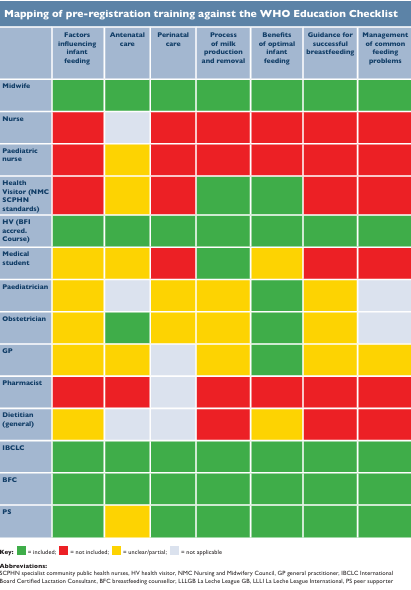
Mapping of pre-registration training standards against the WHO Education Checklist

The UK WBTI assessment maps national minimum standards for training on infant feeding topics against the Educational Checklist from WHO.

The WBTI mapping shows what any family, in any part of the UK, can expect as a minimum from their local health professionals, including not only midwives and health visitors, but also GPs, paediatricians, dietitians and pharmacists. 

The assessment found some improvements, but many gaps remain, as can be seen in the chart below, with the red indicating the gaps. It is essential that everyone caring for parents have knowledge of breastfeeding. Health workers should be able to support parents’ goals, and avoid inadvertently undermining their infant feeding decisions. 

WBTi summary table of breastfeeding topics in health professional standards

Table of basic standards in breastfeeding topics. More details can be found in Indicator 5 in the full report (Part 1). See Part 2 for a more detailed breakdown.

Author

Dr Alison Spiro is a member of the WBTi Steering Group. She is a retired NCT breastfeeding counsellor, specialist health visitor and hospital and community infant feeding lead, taking both trusts to Baby Friendly accreditation. She completed her MSc in 1994 and PhD in 2004 on Gujarati culture and breastfeeding, doing her fieldwork in Harrow and India. 

Alison is the author of a book ‘Breastfeeding for Public Health, a guide for community health professionals’ published by Routledge. 

WBTi is at BFN Conference 2023!

We are delighted to have been invited to present an overview of the WBTi UK project to the 2023 Breastfeeding Network Conference!

Check back on our blog, or sign up to the blog for notifications, to get all the advocacy links we talk about.

See you there!

Join the 2nd WBTi Assessment of the UK!

Join the 2nd WBTi Assessment of the UK!

Do YOU want to be part of driving change for our children’s future?

The second assessment is now underway. It will run throughout this year and be launched in 2024.

What is the WBTi? 

The World Breastfeeding Trends Initiative (WBTi) is a human rights-based, evidence-informed, collaborative and participatory national assessment of the implementation of key policies and programmes from the WHO’s Global Strategy for Infant and Young Child Feeding, and is a project developed by the International Baby Food Action Network (IBFAN). Currently nearly 100 countries are taking part.

WBTI Indicators of Policy and Programmes

  1. National policy, programme, and coordination 
  2. Baby Friendly Initiative
  3. International Code of Marketing of Breastmilk Substitutes
  4. Maternity protection in the workplace   
  5. Health professional training  
  6. Community based support
  7. Information support and communications
  8. Infant feeding and HIV
  9. Infant and young child feeding during emergencies     
  10. Monitoring and evaluation 

In 2016, the UK scored just 50.5/ 100 on these ten key policy indicators.

WBTi brings together the main government agencies, health professional bodies, and civil society organisations involved in infant and maternal health and nutrition in each country to work together to collect information, identify gaps and generate recommendations for action. This Core Group must be free of conflicts of interest from the baby feeding industry (all infant or toddler milks up to 3 years, baby foods, bottles or teats).

The Global Breastfeeding Collective, led by WHO and UNICEF, recommend that the WBTi process be repeated, at least every 5 years, to monitor implementation of key policies, and include this in each country’s score on the Global Breastfeeding Scorecard. 

Volunteers wanted

Many volunteers contributed to the success of the first UK WBTI assessment in 2016.

Your contribution is valuable, large or small: 

  • Writing
  • Social media
  • Graphic design
  • Advocacy
  • Freedom of Information requests.
  • Fundraising
  • Mapping infant feeding training standards
  • Auditing numbers of breastfeeding counsellors and peer supporters
  • Project management
  • Virtual assistant skills
  • Parliamentary research
  • and more

You can find the main WBTi UK 2016 Report Part 1, and Part 2 with supplementary material, with Report Cards for each of the four nations and for the UK overall,  here:  https://ukbreastfeeding.org/wbtiuk2016/

Twitter: @wbtiuk 

Facebook: Breastfeeding – WBTi

Facebook page on emergencies: Safely Fed UK – Infant Feeding in Emergencies 

Website

Contact us! wbti@ukbreastfeeding.org

#StepUpForBreastfeeding: We are the Building Blocks #WBW2022

#StepUpForBreastfeeding: We are the Building Blocks #WBW2022

It takes a village to raise a child – we all have a role to play to support breastfeeding mothers and babies. 

We all are the building blocks responsible for supporting new families: partners and family members, health workers, neighbours and community members, religious leaders, employers, academics, governments and policy makers. We can all make a difference. We need to step up to our responsibilities. Everyone needs to understand the importance of breastfeeding – for maternal and infant physical and mental health and wellbeing, for public health, for our economy, and for our planet.

For WBW this year, WABA has produced an extensive suite of materials looking at all these roles and responsibilities. They have outlined the challenges that breastfeeding families face at every stage from conception, through birth, getting breastfeeding off to a good start, and maintaining breastfeeding all the way through starting solids and going back to work, and the solutions we need in each situation – all backed up by links to the latest evidence. 

The #WBW2022 Action Folder pulls all this together: it is a useful resource for anyone using evidence to build policies and best practice. You can download it as a PDF and all the links to research and references will be live.

The UK WBTi team will be highlighting just a few of the concepts this week:

  • Health workers: the importance of relevant, evidence-based. The advertising of follow-on milks, on the media, from 6 months in the UK has led to confusion, resulting in some parents seeing formula milk as equivalent to breastmilk, or that breastfeeding should stop at 6 months.  The International Code needs to be adopted by the UK government in full, to reduce this confusion and protect breastfeeding. training for all those who work with women, infants and young children
  • UNICEF UK Baby Friendly Initiative and the BFHI worldwide sets out ways in which healthcare staff can receive sound, evidence-based, basic training in supporting breastfeeding. 

ALSO join a special webinar from the Global Breastfeeding Collective on BFHI, with some added specialist topics on supporting small and underweight breastfeeding infants, and on infant feeding in emergencies. (7-9 AM BST and again at 4-6 PM BST). Register HERE

  • Community support: Access to skilled, integrated support for all, with a special focus in the GBC webinar on how to support breastfeeding infants who are not gaining well (NICE NG 75,2017). All parents should have easy access to trained healthcare staff- midwives, paediatricians, health visitors and GPs- breastfeeding peer supporters and specialist support (IBCLC, BFCs). Supporting breastfeeding in complex circumstances: Specialist support from IBCLCS, BFCs, or infant feeding leads, integrated with specialist healthcare teams 
  • Protecting infants and young children in emergencies. National policies should guide Local Resilience Forums but these do not exist at present. 
  • The impact of misleading marketing: The International Code. The advertising of follow-on milks, on the media, from 6 months in the UK has led to confusion, resulting in some parents seeing formula milk as equivalent to breastmilk, or that breastfeeding should stop at 6 months.  The International Code needs to be adopted by the UK government in full, to reduce this confusion and protect breastfeeding.
  • Governments with national and local policy makers need to protect all families and support them to make informed feeding decisions free of commercial influence.

What can YOU do?

It is time for a reassessment of the UK’s national infant feeding policies and programmes. YOU could help! Volunteers are welcome with knowledge in any of the ten policy areas (Indicators 1-10), or with skills such as research, writing, graphics, social media and more – feel free to contact us for a chat!

WBTi Key Indicators:

Indicator 1: National policy, programme and coordination
Indicator 2: Baby Friendly Initiative
Indicator 3: International Code of Marketing of Breastmilk Substitutes

Indicator 4: Maternity protection 
Indicator 5: Health professional training
Indicator 6: Community-based support 
Indicator 7: Information support 
Indicator 8: Infant feeding and HIV 

Indicator 9: Infant and young child feeding during emergencies 

Indicator 10: Monitoring and evaluation 

Which one will YOU choose?

Contact us: wbti@ukbreastfeeding.org

Helen Gray MPhil IBCLC is Joint Coordinator of the WBTi UK Steering Group.

Infant Feeding in Emergencies – Resources for supporting families from #Ukraine #IYCFE

Infant Feeding in Emergencies – Resources for supporting families from #Ukraine #IYCFE

Our WBTi work has revealed that in the UK we have no national guidance on the support and feeding of infants and young children, or pregnant or breastfeeding mothers, during emergencies. There is currently a postcode lottery of Local Resilience Forums who include a few details in their advice to the public such as “Remember to pack formula and nappies for your baby”, but there is no national guidance for LRFs and local authorities that they should include infants and young children in their planning.

This page will serve as a repository for resources for those planning services and those providing feeding support for Ukrainian families with infants and young children.

Breastfeeding provides infants with food security, immune protection, and emotional comfort during disasters.
Basic priorities in an emergency:

1) Support new mothers to hold their babies skin to skin and begin breastfeeding within the first hour.

2) Support mothers who are breastfeeding, partially or fully breastfeeding, to continue breastfeeding and increase their milk supply if needed: provide access to skilled feeding support.

3) Protect infants who are not breastfed: Trained infant feeding / nutrition support teams from trusted NGOs like UNICEF will provide access to safe supplies of appropriate infant formula for babies that need it, and support with safe preparation under hazardous conditions.

4) Protect all infants: breastmilk substitutes and feeding equipment (infant formulas and other milks, bottles, teats, breast pumps and also donor human milk) will be provided by trusted NGOs like UNICEF; the public should AVOID sending donations of these into high risk settings, but send donations of funds to trusted NGOS instead. This will enable them to provide families with what is needed on the ground.

These organisations are members of the Infant Feeding in Emergencies Core Group and have created the international Operational Guidance on Infant Feeding in Emergencies. Please consider supporting their work with families with infants and young children.

We have collected links to infant feeding resources in Ukrainian, and also in the languages of countries housing refugee families, for breastfeeding helpers and aid workers in those countries.

Please send us any suggestions for additional resources

We have a few other resources not included here; please email us any enquiries.

NOTE: we will continue to add links and resources to this page, and these organisations are continuing to add further translations into more languages – please make sure that you clear your cache, or ‘refresh’ the page, each time you open any of these links to ensure that you find the most up to date page.

NOTE: We are providing these resources as a public service, but we cannot read the resources in other languages ourselves, so we cannot always vouch for the accuracy of the contents. Please have someone fluent in the language read it for you.

CONTACT: wbti@ukbreastfeeding.org

WHERE TO START? Watch this 4 minute introductory video from Save the Children

Aid worker or emergency planner? Short video here: how can you incorporate best practice into your support for Ukrainian families?

GET INFORMED: Read the first 25 pages of the Guidance for an overview of best practice.

Resources from the Global Breastfeeding Collective, led by WHO and UNICEF

It is important to continue breastfeeding if you are COVID positive: your milk can pass antibodies to your baby! More resources HERE.

UNICEF UK Baby Friendly resources

Guidance for local authorities on infant feeding during COVID19 (from BFI, First Steps Nutrition Trust, and NIFN). First line guidance for UK local authorities responsible for supporting families

The provision of formula in food banks (November 2020)

Statement on infant formula in food banks (November 2020) – signposting

See also the response to Question 11 on formula donations and distribution in their FAQ here

International humanitarian guidelines and operational guidance

Sphere Handbook

Operational Guidance on Infant feeding in Emergencies
for Emergency Relief Staff and Programme Managers

Available in numerous languages

Media Guide and Guide on writing/ talking about infant feeding in emergencies
These are extremely useful for humanitarian aid organisations and for the media in framing the situation

Guidance for helpers not trained in supporting infant feeding

This short leaflet was written for local authorities and those supporting Afghan refugee families but could be useful for those supporting Ukrainian refugees in the UK. It sets the context, lists some useful resources for parents, provides information about making up powdered infant formula correctly and describes useful actions in some possible scenarios.

Infant feeding support resources – multiple languages

Rapid Feeding Assessment Key Phrases in multiple languages (including Ukrainian, Russian, Romanian, Polish and English – scroll down the page)

Simple Points for Helpers – infant feeding in emergencies in multiple languages (including Ukrainian, Russian, Romanian, Polish and English – scroll down the page)


Pictorial counselling cards in many languages including Russian, adapted to include COVID19 recommendations. Some are full pictorial sets, while some are simply the translation matrix.

Infant Feeding flyer for families in transit (including English, Ukrainian, Polish, Russian, updated for COVID19). Developed by the volunteer team from Infant Feeding Support for Refugee Children/ Safely Fed

Posters and booklets in Ukrainian hosted by the Lithuanian IBCLC Association

Pictorial book about breastfeeding (no words) from La Leche League Netherlands. The PDF is free to use for all. Printing and sharing is allowed, as long as the original file (including credits) is unaltered. Price listed on website is for printed version.

Breastfeeding resources in multiple languages including Ukrainian, Romanian, Russian. (From the Missouri Department of Health and Senior Services, USA)

Breastfeeding Matters – A Guide to Breastfeeding for Women and their Families (from best Start, Ontario Canada) can be downloaded free in Russian and other languages

Translations of key phrases, breastfeeding infographics in many languages, and more: Safely Fed European resources

La Leche League International: Variety of resources and infographics in infant feeding in emergencies translated into multiple languages – most are directed at mothers and parents

Global Health Media: Videos on childbirth and breastfeeding topics.

Infant Feeding in Emergencies Social Media resources:

Infant Feeding Support for Refugee Children Facebook Page: Memes/ graphics in multiple languages, with appropriate captions

La Leche League International Facebook page: Memes/ graphics in multiple languages, aimed at mothers and parents

Safely Fed UK Facebook page – volunteers welcome to create graphics in Canva and to monitor the page! Contact WBTi UK: wbti@ukbreastfeeding.org

For policy makers, emergency planners, media and humanitarian aid workers

Policy resources, media guide, training materials: Infant Feeding in Emergencies Core Group

IYCFE Hub: global hub of resources

Background information on breastfeeding in Ukraine: WBTi 2015 Ukraine Assessment Report

Policy resources, translations of key phrases, and more: Safely Fed European resources

Please do contact us if you are interested in volunteering or have some useful resources to share!!

CONTACT: wbti@ukbreastfeeding.org

Helen Gray MPhil IBCLC is Joint Coordinator of the WBTI UK Steering Team, and Policy and Advocacy Lead at Lactation Consultants of Great Britain. Her research interests include human rights and infant and young child feeding in emergencies.

Infant Feeding in Emergencies – Resources for supporting #Afghan families #IYCFE

Infant Feeding in Emergencies – Resources for supporting #Afghan families #IYCFE

Our WBTi work has revealed that in the UK we have no national guidance on the support and feeding of infants and young children, or pregnant or breastfeeding mothers, during emergencies. There is currently a postcode lottery of Local Resilience Forums who include a few details in their advice to the public such as “Remember to pack formula and nappies for your baby”, but there is no national guidance for LRFs and local authorities that they should include infants and young children in their planning.

This page will serve as a repository for resources for those planning services and those providing feeding support for families in crisis in the UK.

Currently there are many gaps in the support for families who have been evacuated from Afghanistan, so resources in Afghan languages are collected here.

Please send us any suggestions for additional resources

We have a few other resources not included here, including Rapid Assessment Tools and Simple Phrases about feeding, and a Peer Counsellor Training Curriculum in Dari; please email us any enquiries.

CONTACT: wbti@ukbreastfeeding.org

NOTE: We are providing these resources as a public service, but we cannot read the resources in other languages ourselves, so we cannot always vouch for the accuracy of the contents. Please have someone fluent in the language read it for you.

UNICEF UK Baby Friendly resources

Guidance on infant feeding during COVID19 (from BFI, First Steps Nutrition Trust, and NIFN)

First line guidance for local authorities responsible for supporting families

The provision of formula in food banks (November 2020)

Statement on infant formula in food banks (November 2020) – signposting

See also the response to Question 11 on formula donations and distribution in their FAQ here

International humanitarian guidelines and operational guidance

Sphere Handbook

Operational Guidance on Infant feeding in Emergencies
Operational Guidance for Emergency Relief Staff and Programme Managers
Available in numerous languages

Guides on writing/ talking about infant feeding in emergencies and Media Guide
These are extremely useful in framing the situation

Guidance for helpers not trained in supporting infant feeding

This short leaflet sets the context, lists some useful resources for parents, provides information about making up powdered infant formula correctly and describes useful actions in some possible scenarios.

Infant feeding resources – multiple languages

Rapid Assessment tools in various languages – contact wbti@ukbreastfeeding.org

Infant Feeding Counselling resources
Pictorial counselling cards in many languages, adapted to include COVID19 recomendations

Infant Feeding flyer for families in transit (English, Arabic, Farsi, Kurdish)

Developed by the volunteer team from Infant Feeding Support for Refugee Children/ Safely Fed

Email us for more languages

Pictorial book about breastfeeding (no words) from La Leche League Netherlands

The PDF is free to use for all. Printing and sharing is allowed, as long as the original file (including credits) is unaltered. Price listed on website is for printed version.

Breastfeeding resources in multiple languages (Missouri Department of Health and Senior Services, USA)

Infant Feeding in Emergencies Social Media resources:

Support for Refugee Children Facebook Page
Memes/ graphics in multiple languages, with appropriate captions

Safely Fed UK Facebook page – volunteers welcome to create graphics in Canva and to monitor the page! Contact WBTi UK: wbti@ukbreastfeeding.org

Resources in Afghan languages: Dari and Farsi

Background information on breastfeeding in Afghanistan: WBTi 2019 report on Afghanistan

Pictorial counselling cards for Afghanistan, in Dari

Infant Feeding flyer for families in transit: versions in Farsi and English

Developed by the volunteer team from Infant Feeding Support for Refugee Children/ Safely Fed

Breastfeeding Confidence booklet by the Australian Breastfeeding Association, in Dari

Video from UNICEF in Dari

Breastfeeding Matters – An Important Guide to Breastfeeding for Women and their Families (from best Start, Ontario Canada) can be downloaded free in Farsi

Breastfeeding information in Farsi and other languages (Missouri Department of Health and Senior Services, USA)

Please do contact us if you are interested in volunteering or have some useful resources to share!!

CONTACT: wbti@ukbreastfeeding.org

Helen Gray MPhil IBCLC is Joint Coordinator of the WBTI UK Steering Team, and Policy and Advocacy Lead at Lactation Consultants of Great Britain. Her research interests include human rights and infant and young child feeding in emergencies.

Seeing the world through babies’ eyes

Seeing the world through babies’ eyes

This week (7- 12 June) is Infant Mental Health Awareness Week and the theme is ‘20:20 vision: Seeing the world through babies’ eyes’. The Week is led by the Parent-Infant Foundation (PIF) and the First 1001 Days Movement, a collaboration of relevant organisations with the PIF as secretariat, which is being launched during the week.

What is infant mental health? It is the emotional wellbeing of babies. The Movement’s vision is that ‘every baby has loving and nurturing relationships in a society that values emotional wellbeing and development in the first 1001 days, from pregnancy, as the critical foundation for a healthy and fulfilling life.’

What babies want is what they need and these needs are basic. As obstetrician Grantly Dick-Read  wrote in the mid 20th century:  

“The newborn has only three demands. They are warmth in the arms of its mother, food from her breasts, and security in the knowledge of her presence. Breastfeeding satisfies all three.”

They do also need to receive attention from other humans. If their needs are usually met, babies can form secure relationships (attachment) with their caregivers. Usually, there is one primary caregiver, most commonly the mother. Attachment theory was developed by the psychoanalyst John Bowlby in the 1950s. An attachment figure who cares responsively for the infant provides a secure base. It is believed that behaviours by the infant to stay close when separated, like screaming and clinging, have been reinforced by natural selection (see What is attachment theory).

Babies are vulnerable – as Donald Winnicott, paediatrician and psychoanalyst, among his other insightful quotes, stated:

‘There is no such thing as a baby, there is a baby and someone’.

However, infants are not passive as they communicate by giving cues to their needs, such as the rooting reflex when hungry. If their needs are not responded to quickly, they become upset. Dr. Edward Tronick’s ‘still face’ experiments in the 1970s showed the importance of human connection for an infant. If the parent’s face is still and unresponsive to her baby, the baby looks confused and then becomes distressed. The experiments also showed that ruptures in a relationship like this are easily repaired. Parents do not need to respond perfectly.

However, when there is repeatedly no response to a baby’s distress, as in sleep training where the baby is left alone and expected to adapt, it was found that the babies’ behaviour changed so that by the third night they were no longer crying but their cortisol (stress hormone) levels were still high so there was a mismatch between behaviour and physiology; instead of learning to self-soothe it seems as though they were giving up so in despair. 

The significance of the care babies receive is that their experiences, starting before birth, influence the neural connections that are formed in the developing brain – the ‘wiring’. A parent who is emotionally not really available to the baby (so not attuned to their needs) will find it difficult either to respond or to respond appropriately, providing an unintentional ‘still face’ or angry face. The parents could be ill, depressed, addicted, suffering domestic abuse, desperately worried about their financial situation, overloaded with responsibilities………It is therefore crucial for a society to care for parents so that they can be emotionally available to their children.

Feeding is a crucial part of nurturing care and breastfeeding facilitates the process.There is considerable evidence that not being breastfed is linked to poorer physical health in infants (Lancet, 2016). Breastfeeding provides personalised nutrition. Antibodies and other components in breastmilk reduce the chance and severity of infections. Oligosaccharides in breastmilk feed and thus favour beneficial bacteria in the infant’s gut and this helps the development of a healthy immune system. It is difficult to allow for confounding factors in studies on breastfeeding but reviews show it is linked with better cognitive performance, which is likely to be due to the fatty acids in breastmilk. But what about any impact on emotional development? There are studies which suggest that being breastfed is associated with paying more attention to positive emotions in others.  Breastmilk contains the calming hormone oxytocin, which stimulates social interactions, and which is further released through touch and suckling, so the moods of both mother and baby benefit. Several studies indicate that mothers who are breastfeeding tend to touch their babies more, are more responsive and tend to gaze at them more, all of which will help the infant’s emotional wellbeing. The Unicef UK Baby Friendly Initiative leaflet, Building a Happy Baby, provides practical suggestions for parents to support their baby’s brain development and addresses myths and realities. 

Jones found that breastfeeding helps to protect infants from the harmful effects of maternal depression

Mothers who stop breastfeeding before they want to are at greater risk of postnatal depression (Borra et al 2014) so mothers need easy access to breastfeeding support to help them continue, thereby benefitting their babies physically and emotionally. Sadly, there are barriers to breastfeeding throughout society, as outlined in the WBTi UK report.

Parents and carers urgently need more support, especially during the stresses and isolation of lockdown and the COVID19 pandemic. We call on government to make infants and their families a high priority during the pandemic and in our plans to rebuild a stronger society.

Photo used with permission

Patricia Wise is an NCT breastfeeding Counsellor and a member of the WBTi UK Steering Group

Lockdown with a baby?

Lockdown with a baby?

Maternal Mental Health Day is on the first Wednesday in May, which this year was 6th May.  A group of organisations has launched a new survey to try to capture parents’ experiences in the context of a global pandemic and social distancing. If the survey can be distributed widely to parents with a baby/child under 2 year, or are pregnant, to gather the views of parents of a range of ages, ethnicities and experiences, the data will be particularly useful.

Click HERE for survey link.

The collaborating organisations include members of the First 1001 Days Movement, which is coordinated by the Parent-Infant Foundation, Home-Start UK, Best Beginnings, and the Maternal Mental Health Alliance. The WBTi UK Steering Group have also signed up to support the First 1001 Days Movement.

Do you know anyone who is pregnant or has a child under 2 years who might be interested in completing the survey? Please pass on the survey link. The survey is expected to be open for about 3 weeks, so until late May.

Headline results of the survey are due to be released in Infant Mental Health Awareness Week (7-12 June).

Photo courtesy of Paul Carter, We Do It In Public (wdiip.co.uk)

Patricia Wise is an NCT Breastfeeding Counsellor and a member of the WBTi UK Steering Group.