Adjournment debate in UK Parliament on infant feeding

Adjournment debate in UK Parliament on infant feeding

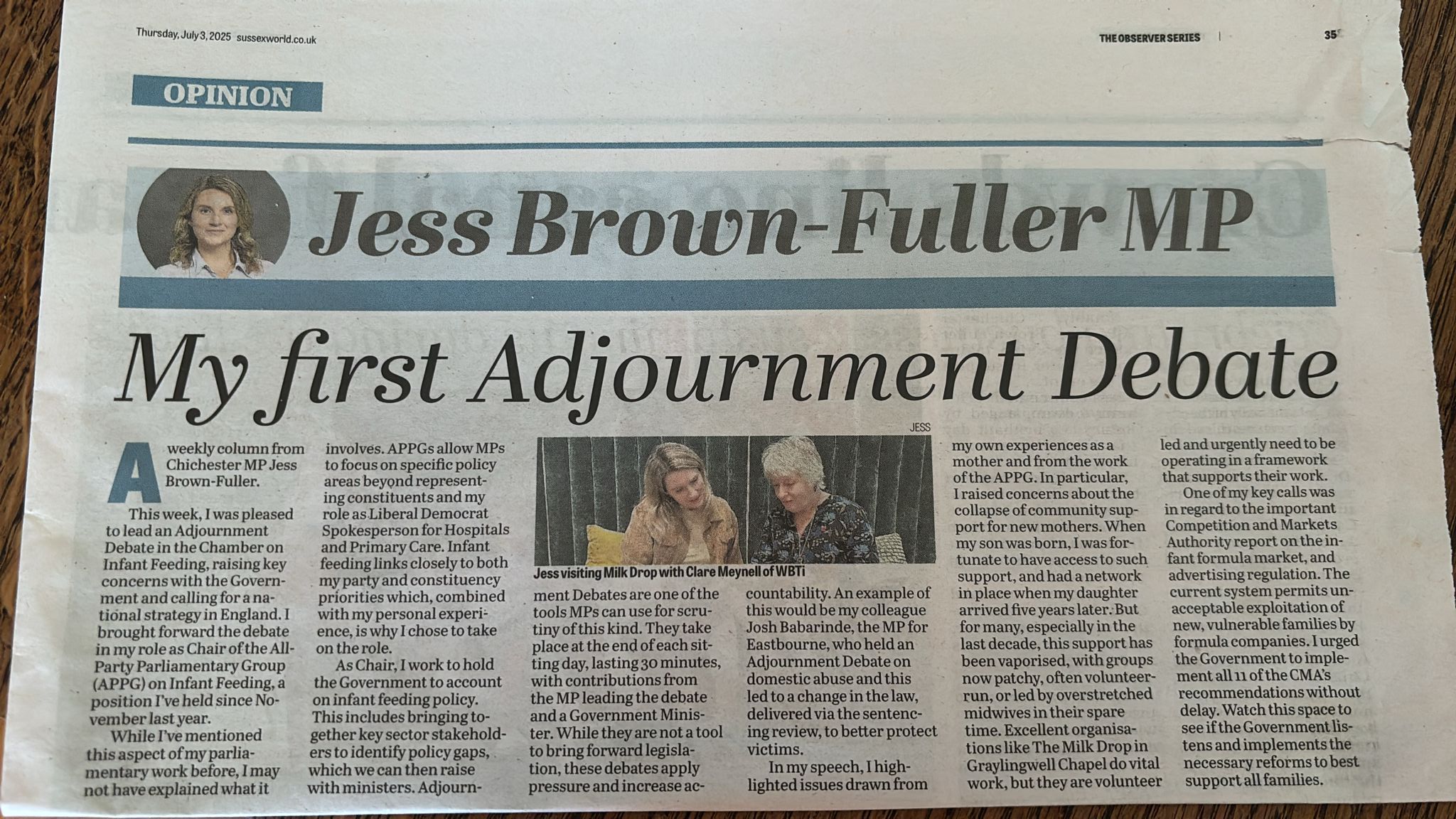
On 1 July, Chichester MP Jess Brown-Fuller led her first adjournment debate in the House of Commons Chamber. 

She raised key concerns with the Government, calling for a national strategy for England. In her role as chair of the All-Party Parliamentary Group (APPG) on Infant Feeding she focuses on specific policy areas, beyond her constituency work. She aims to hold the government to account, by raising identified gaps in policy with the relevant government minister. Such debates apply pressure to increase accountability so may lead to a change in the law. 

Jess highlighted her own positive experience of a network of community support when her children were born a decade ago but which is now, at best, patchy or non-existent. She urged the government to implement all eleven Competition and Markets Authority (CMA) final report recommendations to protect families from the current unacceptable exploitation by the infant formula market.

Several MPs supported the debate by sharing both their own experiences and stories from constituents about the importance of skilled breastfeeding support.

WBTi in Parliament

For the first time, the WBTi report was mentioned by a minister on the floor of the House of Commons. Ashley Dalton, Parliamentary Under-Secretary of State for Public Health and Prevention in the Department of Health and Social Care, replied on behalf of the government:

 “We recognise the concerns raised in the World Breastfeeding Trends Initiative’s United Kingdom report and are considering the recommendations” and “we know through the report that England scores poorly, and we want to change that.” See Column 260 in the Hansard report of the debate.

MPs who attended:

Maya Ellis, Labour MP Ribble Valley

Jim Shannon, DUP MP Strangford ( Northern Ireland ) 

Connor Rand, Labour MP Altrincham and Sale West

Samantha Niblett, Labour MP South Derbyshire

David Reed, Conservative MP Exmouth and Exeter East

David Chadwick, Liberal Democrat MP Brecon Radnor and Cwm Tawe (Wales)

Dr Danny Chamber, Liberal Democrat Winchester
Article in the Sussex Express

Media follow-up

An article in The Independent on 11th August by journalist Abbie Llewellyn followed up on the Adjournment Debate.

Other outlets which picked up on the WBTi Report launch and the debate:

ITV Regional News interviewed Jess Brown-Fuller regarding the outcome of the CMA report, (a market study on infant formula and follow-on formula) set to be released on 1st September 2025.

The i Paper ran an article by journalist Emma Morgan on infant formula marketing.

Parliament News magazine ran a piece by Jess Brown-Fuller MP: Building the ‘healthiest generation ever’ starts with making sure every child has a fair start in life.

The Nursing Times published an article about the WBTi Report launch and policy event, hosted by Jess Brown Fuller, highlighting quotes from iHV CEO Alison Morton, Vicky Sibson of First Steps Nutrition Trust, and Jess Brown-Fuller.

The British Medical Journal on 26 June included a further news article by Gareth Iacobucci, about the WBTi launch and our Call to Action for the government to implement the CMA recommendations in full: “Formula milk: Overpriced and misleading products are risking child health, say campaigners.” BMJ 2025; 389:r1333.

Other recent relevant contributions by Jess Brown-Fuller MP to Parliamentary debates 

Prior to the Adjournment debate on 1st July there was a Parental Leave Review debate led by Justin Madders MP, the Parliamentary Under-Secretary of State for Business and Trade. Various members of the APPG on Infant Feeding attended the meeting. Jess Brown-Fuller asked about the impact of breastfeeding policies on mothers returning to work. Despite the WBTi findings that mothers are struggling with continuing to breastfeed upon return to work, Justin Madders explained that this fell slightly outside the scope of the review but he was happy to correspond on the matter.

On 7th July there was a debate on Giving Every Child the Best Start in Life Strategy, led by Bridget Phillipson MP, Secretary of State for Education. Jess Brown-Fuller asked for confirmation that Best Start centres will be firmly rooted in evidence-based feeding support. The Secretary of State gave an assurance. 

Photo credit: Office of Jess Brown-Fuller MP

Jess Brown-Fuller MP looking at the WBTi Report with Clare Meynell

Author: Clare Meynell RM (rtd), IBCLC

Clare had a long career as a midwife and infant feeding lead achieving the UNICEF UK Baby Friendly Initiative Gold award accreditation at her local hospital. Currently, with Helen Gray, she jointly coordinates the UK WBTI working group and co-presented the first report for the UK in Parliament in November 2016 and the second in 2024.

Clare still volunteers her knowledge and experience at a regular mother and baby support group. 

Her focus recently has been to create “Actions for Change” through the WBTi report recommendations so that the next generation of mothers are enabled to achieve their personal breastfeeding goals and that society better understands the health-giving properties of human milk as the physiologically normal first food for babies. 

Presentation at the APPG on Infant Feeding

Presentation at the APPG on Infant Feeding

WBTi UK Steering Group members, Helen, Clare, Alison and Patricia, were very pleased to be invited to give a presentation on the 2024 Report to the All-Party Parliamentary Group (APPG) on Infant Feeding on 18 June, 2025. This APPG, an informal cross-party group, is hosted by Liberal Democrat MP for Chichester, Jess Brown-Fuller, who is a staunch advocate for breastfeeding. Meetings are quarterly.

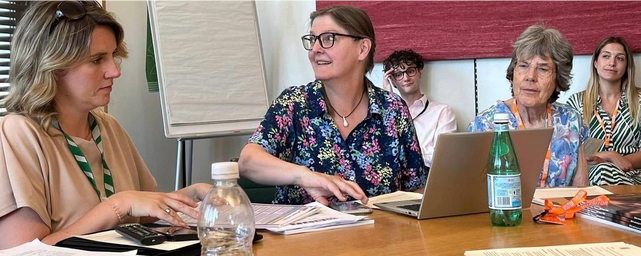
(left to right) Jess Brown-Fuller MP, Helen and Patricia during the presentation

The hybrid event was held in Portcullis House, which is close to the Houses of Parliament and overlooks the River Thames.

At the meeting, Helen and Patricia gave an overview of the Report’s findings. This triggered a range of questions from the audience in the room and online. Attendees included Labour MP for Ribble Valley, Maya Ellis, and Liberal Democrat MP for mid-Sussex, Alison Bennett, along with representatives of Royal Colleges and local public health teams, as well as the breastfeeding support organisations.

(left to right) Jayne Joyce and Emily Lunny (LLLGB), Helen Gray and Patricia Wise (WBTi Steering Group) and Katie Pereira-Kotze (First Steps Nutrition Trust)

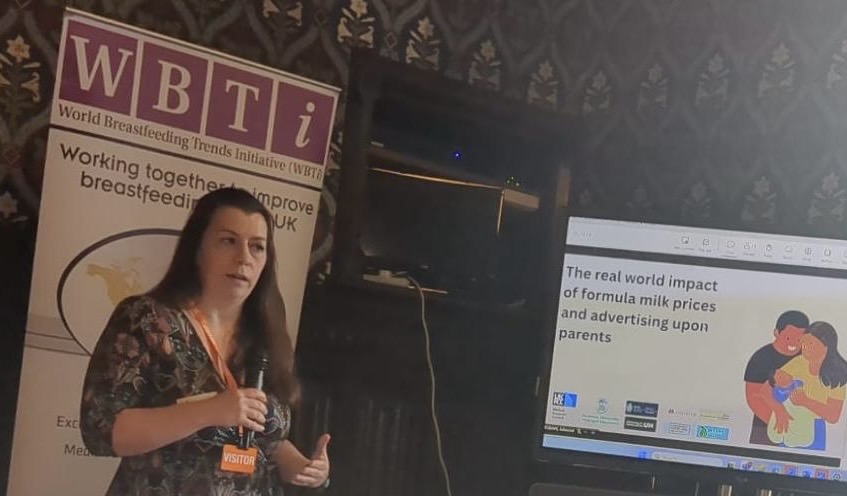
Presentation title slide

APPG meetings

If you would like to be notified about future Infant Feeding APPG meetings, please contact Edmund Legrave, Parliamentary Assistant for Jess Fuller-Brown: edmund.legrave@parliament.uk

Author: Patricia Wise

Patricia Wise is an NCT Breastfeeding counsellor and a member of the WBTi UK Steering Group. She has a particular interest in health professional training in breastfeeding and her e-book, Supporting mothers who breastfeed: a guide for trainee and qualified doctors, is available on the WBTi website. 

New WBTi Report: Parliamentary launch

New WBTi Report: Parliamentary launch

Jess Brown-Fuller, MP for Chichester, hosted the formal launch of the WBTi 2024 UK report on July 24th 2025 in the Jubilee Room at the Houses of Parliament. 

(left to right) Patricia Wise, Clare Meynell, Jess Brown-Fuller MP with visiting baby Niamh, Helen Gray, Alison Spiro

Kate Quilton

Investigative journalist Kate Quilton drew on her own experiences in emphasising the importance of a  policy framework, and chaired the Q&A.

What do policymakers need to do, to protect and support breastfeeding? 

The WBTi 2024 report made a number of key policy recommendations on maternity rights, marketing regulations and food safety.

WBTi’s ‘big ask’

The aim of the WBTi project is to galvanise action to implement report recommendations, thus improving support and protection for infant feeding. Our single most immediate actionable ask is for the UK and devolved governments to adopt the eleven recommendations of the Competition and Markets Authority (CMA) report on regulating misleading infant formula promotion. Adopting these would help to end the profiteering we have seen in recent years (formula prices have gone up by 24%! including one by 49%!). This would also help families make informed infant feeding decisions and for them to be able to access affordable products to feed their babies if needed.

The CMA recommendations encompass many of the WBTi UK recommendations on protecting families from exploitative marketing. In addition, WBTi calls for the regulations to apply to ALL formulas from 0-36 months. This would help end the loopholes that companies use in the marketing of formulas for older babies and toddlers, or for special medical purposes.

Professor Nigel Rollins

Professor Nigel Rollins, who formerly worked for the World Health Organisation and is now at Queens University, Belfast, gave a policy overview and more details about our ‘Call to Action’. 

Parents are struggling

Professor Amy Brown of Swansea university stunned the room when she revealed some of the shocking findings of her research into the challenges families are facing to afford the high prices of formula.

Professor Amy Brown

Her presentation called for:

  • Lower priced milks – consistent, reliable and affordable pricing
  • Accurate information, not adverts
  • Parents should be supported to feed their baby without worrying about cost
  • For the health and well-being of parents and babies to be put before profits

She shared powerful testimony about the impact of the high cost of formula from parents themselves:

Breastfeeding is important

“Breastfeeding is a human right for both mother and child” (UN human rights joint statement 2016).

WBTi work is built on a foundation of human rights. UN human rights experts have made it clear that breastfeeding is a right of the dyad, the mother and infant together. The rights of one don’t supercede the other; mother and baby have rights as a dyad. It is the responsibility of our governments to support and protect those rights, by providing skilled health care, maternity protection at work, and protecting the rights of women and families to make their own informed decisions about how to feed their baby, without commercial influence.

What is the impact of low breastfeeding rates in the UK?

High costs for the NHS:

Low UK breastfeeding rates are costing the NHS £millions:

  • 54,000 more GP appointments
  • 9,500+ additional hospitalisations

Research has shown that basic interventions to support more mothers to breastfeed for longer could pay for themselves within a year. (Renfrew et al 2012)

Costing our planet:

The formula and dairy industries have a significant footprint both of greenhouse gases and water.

“For the UK alone, carbon emission savings gained by supporting mothers to breastfeeding would equate to taking between 50,000 and 77,500 cars off the road each year” (Joffe et al 2019)

Key recommendations from the WBTi Core Group

Our governments must address the ‘baby blind spots’ in national policies:

  • Protect all infants by adopting in full the recommendations of the CMA, and extending the regulations to cover all infant milks up to 3 years, in order to address current loopholes in marketing formulas for older infants or for special medical purposes.
    • WBTi recommends that regulations on safety and on marketing should be applied to feeding equipment such as bottles, teats, and other equipment, as well.
  • Protect infants and young children in emergencies by developing guidance on their care.
  • Protect the health and the rights of women and children by providing statutory rights for flexible breastfeeding/ expressing breaks and suitable facilities in the workplace and in education.
  • Develop a national infant feeding strategy and leadership for England.
  • Improve monitoring and evaluation by strengthening and coordinating data collection systems.

Find our 2016 and 2024 reports here.

Sign up for our mailing list here (we send very few emails! And never share your details).

Donate to support our work here.

Author: Helen Gray

Helen is a member of the Steering Group for  the World Breastfeeding Trends Initiative (WBTi) project in the UK.

An IBCLC and La Leche League Leader (breastfeeding counsellor), she has served as both Communications Co-Chair and Policy and Advocacy Lead for Lactation Consultants of Great Britain. She represents La Leche League of Great Britain on the UK Baby Feeding Law Group (BFLG), which works to bring the International Code of Marketing of Breastmilk Substitutes into UK law.

Helen’s background in anthropology and human evolution has influenced her interest in how breastfeeding and the way we nurture our babies are influenced by both human biology and culture.

She is currently doing a research degree on the need for strong policies to protect infant feeding in emergencies. She has written several articles and chapters on the subject and served on the Advisory Panel for a London Food Resilience research project. She now represents BFLG on the global Infant Feeding in Emergencies Core Group.

New WBTi report: first findings

New WBTi report: first findings

Health professional training needs to include more on infant feeding

Gaps in health professional training on infant feeding have been one of the most talked-about findings of the WBTi project in the UK.

The soft launch of the second WBTi Report on UK infant feeding policies and programmes was held at Guy’s Hospital, London, on March 25th, with a focus on gaps in pre-registration training for health professionals.

The WBTi assessment also includes in-service training. In the UK, the main source is UNICEF Baby Friendly Initiative training.

What were the gaps?
Little has changed in these high level universal standards since the 2016 WBTi report. The most striking gap is that the general requirements for all nurses do not explicitly include infant feeding; this means that university health visitor training programs are not required to include much on breastfeeding, unless they are UNICEF Baby Friendly-accredited. Only 21% of university health visitor training programmes are BFI-accredited, although many health visitors will go on to receive in-service training as  69% of health visiting services in the community are now BFI- accredited.  Nurses in other parts of the health system, from emergency rooms to oncology or women’s health, and even in paediatric and neonatal wards, have not routinely received training in breastfeeding.  

Little support for hospitalised mothers

The WBTi team also conducted a survey of infant feeding leads on NHS Trust policies to support hospitalised mothers who are breastfeeding in wards other than maternity, for example to maintain their milk supply. We found that many Trusts lack such a policy. Scotland does have a guideline that has now been rolled out across the NHS in Scotland.

Sharing our findings

The event was well attended by key stakeholders, including representatives from the Department of Health and Social Care and devolved nations, health professional bodies, UNICEF Baby Friendly Initiative, and members of the WBTI Core Group.

The WBTi Steering Group – Helen, Clare, Alison and Patricia

Dr Bob Boyle of Imperial College set the scene with an historical background of infant feeding in the UK and globally. The WBTi team gave an overview of the report, emphasising the importance of every mother in the UK having access to an integrated network of infant feeding support, and the essential need for political commitment to enable this.

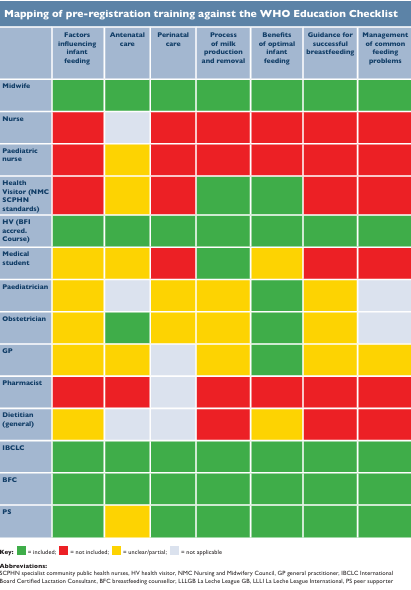
Mapping of pre-registration training standards against the WHO Education Checklist

The UK WBTI assessment maps national minimum standards for training on infant feeding topics against the Educational Checklist from WHO.

The WBTI mapping shows what any family, in any part of the UK, can expect as a minimum from their local health professionals, including not only midwives and health visitors, but also GPs, paediatricians, dietitians and pharmacists. 

The assessment found some improvements, but many gaps remain, as can be seen in the chart below, with the red indicating the gaps. It is essential that everyone caring for parents have knowledge of breastfeeding. Health workers should be able to support parents’ goals, and avoid inadvertently undermining their infant feeding decisions. 

WBTi summary table of breastfeeding topics in health professional standards

Table of basic standards in breastfeeding topics. More details can be found in Indicator 5 in the full report (Part 1). See Part 2 for a more detailed breakdown.

Author

Dr Alison Spiro is a member of the WBTi Steering Group. She is a retired NCT breastfeeding counsellor, specialist health visitor and hospital and community infant feeding lead, taking both trusts to Baby Friendly accreditation. She completed her MSc in 1994 and PhD in 2004 on Gujarati culture and breastfeeding, doing her fieldwork in Harrow and India. 

Alison is the author of a book ‘Breastfeeding for Public Health, a guide for community health professionals’ published by Routledge. 

WBTi is at BFN Conference 2023!

We are delighted to have been invited to present an overview of the WBTi UK project to the 2023 Breastfeeding Network Conference!

Check back on our blog, or sign up to the blog for notifications, to get all the advocacy links we talk about.

See you there!

Join the 2nd WBTi Assessment of the UK!

Join the 2nd WBTi Assessment of the UK!

Do YOU want to be part of driving change for our children’s future?

The second assessment is now underway. It will run throughout this year and be launched in 2024.

What is the WBTi? 

The World Breastfeeding Trends Initiative (WBTi) is a human rights-based, evidence-informed, collaborative and participatory national assessment of the implementation of key policies and programmes from the WHO’s Global Strategy for Infant and Young Child Feeding, and is a project developed by the International Baby Food Action Network (IBFAN). Currently nearly 100 countries are taking part.

WBTI Indicators of Policy and Programmes

  1. National policy, programme, and coordination 
  2. Baby Friendly Initiative
  3. International Code of Marketing of Breastmilk Substitutes
  4. Maternity protection in the workplace   
  5. Health professional training  
  6. Community based support
  7. Information support and communications
  8. Infant feeding and HIV
  9. Infant and young child feeding during emergencies     
  10. Monitoring and evaluation 

In 2016, the UK scored just 50.5/ 100 on these ten key policy indicators.

WBTi brings together the main government agencies, health professional bodies, and civil society organisations involved in infant and maternal health and nutrition in each country to work together to collect information, identify gaps and generate recommendations for action. This Core Group must be free of conflicts of interest from the baby feeding industry (all infant or toddler milks up to 3 years, baby foods, bottles or teats).

The Global Breastfeeding Collective, led by WHO and UNICEF, recommend that the WBTi process be repeated, at least every 5 years, to monitor implementation of key policies, and include this in each country’s score on the Global Breastfeeding Scorecard. 

Volunteers wanted

Many volunteers contributed to the success of the first UK WBTI assessment in 2016.

Your contribution is valuable, large or small: 

  • Writing
  • Social media
  • Graphic design
  • Advocacy
  • Freedom of Information requests.
  • Fundraising
  • Mapping infant feeding training standards
  • Auditing numbers of breastfeeding counsellors and peer supporters
  • Project management
  • Virtual assistant skills
  • Parliamentary research
  • and more

You can find the main WBTi UK 2016 Report Part 1, and Part 2 with supplementary material, with Report Cards for each of the four nations and for the UK overall,  here:  https://ukbreastfeeding.org/wbtiuk2016/

Twitter: @wbtiuk 

Facebook: Breastfeeding – WBTi

Facebook page on emergencies: Safely Fed UK – Infant Feeding in Emergencies 

Website

Contact us! wbti@ukbreastfeeding.org

#StepUpForBreastfeeding: We are the Building Blocks #WBW2022

#StepUpForBreastfeeding: We are the Building Blocks #WBW2022

It takes a village to raise a child – we all have a role to play to support breastfeeding mothers and babies. 
We all are the building blocks responsible for supporting new families: partners and family members, health workers, neighbours and community members, religious leaders, employers, academics, governments and policy makers. We can all make a difference. We need to step up to our responsibilities. Everyone needs to understand the importance of breastfeeding – for maternal and infant physical and mental health and wellbeing, for public health, for our economy, and for our planet.

For WBW this year, WABA has produced an extensive suite of materials looking at all these roles and responsibilities. They have outlined the challenges that breastfeeding families face at every stage from conception, through birth, getting breastfeeding off to a good start, and maintaining breastfeeding all the way through starting solids and going back to work, and the solutions we need in each situation – all backed up by links to the latest evidence. 

The #WBW2022 Action Folder pulls all this together: it is a useful resource for anyone using evidence to build policies and best practice. You can download it as a PDF and all the links to research and references will be live.

The UK WBTi team will be highlighting just a few of the concepts this week:

  • Health workers: the importance of relevant, evidence-based. The advertising of follow-on milks, on the media, from 6 months in the UK has led to confusion, resulting in some parents seeing formula milk as equivalent to breastmilk, or that breastfeeding should stop at 6 months.  The International Code needs to be adopted by the UK government in full, to reduce this confusion and protect breastfeeding. training for all those who work with women, infants and young children
  • UNICEF UK Baby Friendly Initiative and the BFHI worldwide sets out ways in which healthcare staff can receive sound, evidence-based, basic training in supporting breastfeeding. 

ALSO join a special webinar from the Global Breastfeeding Collective on BFHI, with some added specialist topics on supporting small and underweight breastfeeding infants, and on infant feeding in emergencies. (7-9 AM BST and again at 4-6 PM BST). Register HERE

  • Community support: Access to skilled, integrated support for all, with a special focus in the GBC webinar on how to support breastfeeding infants who are not gaining well (NICE NG 75,2017). All parents should have easy access to trained healthcare staff- midwives, paediatricians, health visitors and GPs- breastfeeding peer supporters and specialist support (IBCLC, BFCs). Supporting breastfeeding in complex circumstances: Specialist support from IBCLCS, BFCs, or infant feeding leads, integrated with specialist healthcare teams 
  • Protecting infants and young children in emergencies. National policies should guide Local Resilience Forums but these do not exist at present. 
  • The impact of misleading marketing: The International Code. The advertising of follow-on milks, on the media, from 6 months in the UK has led to confusion, resulting in some parents seeing formula milk as equivalent to breastmilk, or that breastfeeding should stop at 6 months.  The International Code needs to be adopted by the UK government in full, to reduce this confusion and protect breastfeeding.
  • Governments with national and local policy makers need to protect all families and support them to make informed feeding decisions free of commercial influence.

What can YOU do?

It is time for a reassessment of the UK’s national infant feeding policies and programmes. YOU could help! Volunteers are welcome with knowledge in any of the ten policy areas (Indicators 1-10), or with skills such as research, writing, graphics, social media and more – feel free to contact us for a chat!

WBTi Key Indicators:

Indicator 1: National policy, programme and coordination
Indicator 2: Baby Friendly Initiative
Indicator 3: International Code of Marketing of Breastmilk Substitutes

Indicator 4: Maternity protection 
Indicator 5: Health professional training
Indicator 6: Community-based support 
Indicator 7: Information support 
Indicator 8: Infant feeding and HIV 

Indicator 9: Infant and young child feeding during emergencies 

Indicator 10: Monitoring and evaluation 

Which one will YOU choose?

Contact us: wbti@ukbreastfeeding.org

Helen Gray MPhil IBCLC is Joint Coordinator of the WBTi UK Steering Group.

#WBW2021 Protect Breastfeeding: A Shared Responsibility – Peer Support

#WBW2021  Protect Breastfeeding: A Shared Responsibility – Peer Support

A network of trained peer support is an essential part of high quality integrated breastfeeding services.

Unicef UK Baby Friendly Initiative (BFI) outlines three components that good local breastfeeding services must include, in order to be awarded Baby Friendly accredited status.

Basic, or Routine Care

All health workers who work with new families (health visitors and any allied healthcare assistants in the community services) have been trained to BFI standard (approximately 18 hours of initial in service training, with yearly updates of an hour or more).

Additional services

Here BFI outlines how every health visiting and community service must be embedded in and well supported by a network of trained peer supporters, or other social and trained breastfeeding support. NICE recommends that peer support programmes be externally accredited. Good practice includes not only training, but also regular supervision and updates of skills and knowledge. Typical peer support programmes require peer supporters to be experienced breastfeeding mothers, and often expects them to come from similar communities as the population they are supporting. Training generally is part time, over 16-36 hours. Peer supporters work in a supervised setting, acting as an “informed friend,” and referring complex cases on to health professionals or an advanced breastfeeding practitioner such as an IBCLC or breastfeeding counsellor, using a referral pathway.

Breastfeeding counsellors in the UK are also experienced breastfeeding mothers, so they also provide a type of peer support, or “mother-to-mother” support. Their training typically take around two years, and they are autonomous practitioners, who can be responsible for leading their own local breastfeeding support groups, usually through one of the main UK breastfeeding voluntary organisations.

Mothers who are experiencing breastfeeding challenges often need more than one visit – and they need the time that it requires for skilled listening as well as exploration of possible breastfeeding strategies to resolve the issue. Although many health visitors have additional breastfeeding training and skills, the health visitor workforce is vastly overstretched, and it simply isn’t possible to provide the time and the number of visits that many breastfeeding mothers need.

But peer support programmes can provide this – they offer groups where lonely mothers can meet others and gain confidence in their own mothering, alongside skilled listening and well- informed support. Many mothers will find their own “village” in their local breastfeeding support group, and will return again and again. Some will go on to train as peer supporters or breastfeeding counsellors themselves.

Peer support groups are the beating heart of breastfeeding support

Helen Gray, WBTi Joint Coordinator
WBTi audit of peer support and breastfeeding counsellors provided by the voluntary sector, 2016
In Part 2 of our WBTi UK Report

Specialist support

Every area should have a referral pathway to specialist care at the IBCLC (International Board Certified Lactation Consultant) or similar level, for those complex cases where breastfeeding issues cannot be resolved at the level of basic/ routine care or by additional peer support.

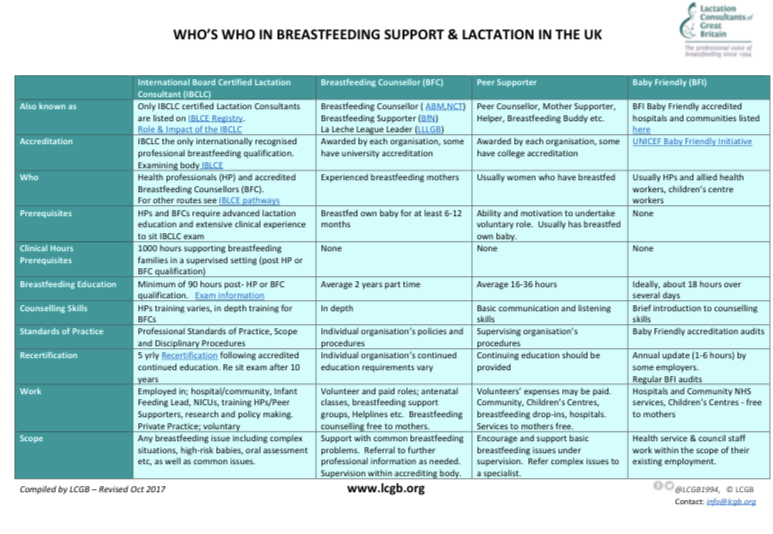
The different roles of breastfeeding support in the UK have been outlined in the chart below:

Who’s Who in Breastfeeding Support and Lactation in the UK, from Lactation Consultants of Great Britain

WBTi’s research: Case studies of best practice
The WBTi 2016 Report featured several case studies of areas who showed best practice in providing well joined up, integrated breastfeeding services: Brighton and Harrow.

Case studies of two breastfeeding services providing integrated support, 2016.
In Part 2 of our WBTi UK Report

More recently, our WBTi team has presented posters featuring these and additional case studies of best practices in providing integrated breastfeeding services: Medway, Harrow and Swindon.

WBTi Poster on Integrated Breastfeeding Services.

These examples of best practice in integrated breastfeeding services gave concrete results.

They demonstrated:

– a 2% rise in breastfeeding rates in a socially deprived area in 2018 (Medway),

– a 15% rise in initiation and a 12% rise in continuation of breastfeeding over a six year period (Harrow)

– and a 6% reduction in drop off rates from birth to 6-8 weeks over six years (Swindon).

Our WBTi team are always on the lookout for further examples of best practice in integrated breastfeeding services, and we submit them to Public Health England. Please do contact us if you would like to submit your local services!

Email us at wbti@ukbreastfeeding.org

Sign up to our mailing list HERE

Banner photo credit: Pixabay

Helen Gray MPhil IBCLC is Joint Coordinator of the World Breastfeeding Trends (WBTi) UK Working Group. She is also an accredited Leader (breastfeeding counsellor) with La Leche League of Great Britain.

Shocking gaps in emergency preparedness for Europe’s babies

Shocking gaps in emergency preparedness for Europe’s babies

The Covid-19 pandemic has shown how important it is for countries to protect their citizens from illness.

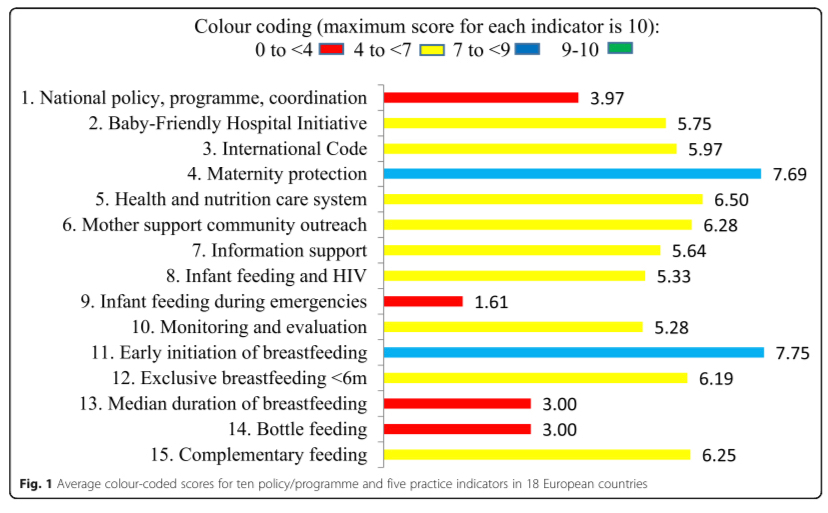
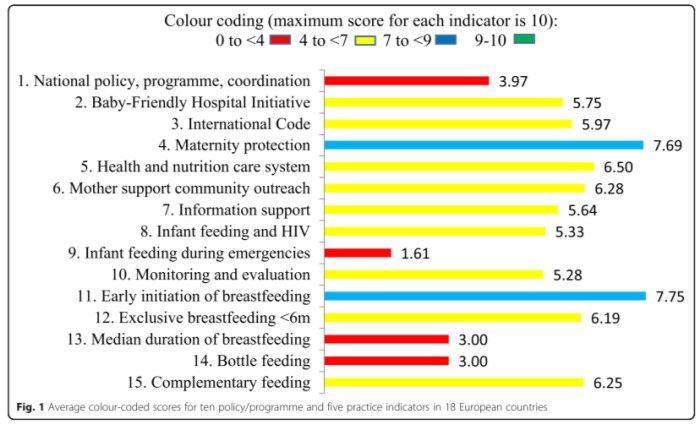
Yet a new WBTi regional report shows gaps in support for families across Europe, with the poorest overall scores in national leadership and, shockingly, emergency preparedness, where the UK scored 0/10. This pandemic is an emergency for infants and young children and only North Macedonia was found to have an adequate strategy.

Babies who are breastfed have better health and resistance to infection, and most mothers want to breastfeed. Yet many European mothers stop or reduce breastfeeding in the early weeks and months, and bottle feeding is prevalent, due to inadequate support from health systems and society.

Launched today, the first European report on infant and young child feeding policies and practices, Are our babies off to a healthy start?, compares 18 countries and identifies the considerable improvements they need to make in supporting mothers who want to breastfeed. A summary report has been published today in the International Breastfeeding Journal .

The full report can be downloaded from the World Breastfeeding Trends Initiative global website.    

The new report, Are our babies off to a healthy start?, compares the  implementation of WHO’s Global Strategy for Infant and Young Child Feeding across 18 European countries. The comparisons show clearly that inadequate support and protection for breastfeeding mothers is a Europe-wide problem. The health of babies, mothers and whole populations  lose out as a result. However, countries do differ considerably. Turkey rates highest overall; the five countries with the lowest scores belong to the European Union. 

     ‘Nutrition is key to achieving the Sustainable Development Goals related to health, education, sustainable development, reduction of inequalities and more.’

Joao Breda, Head, WHO European Office for Prevention and Control of Noncommunicable Diseases

The scope of the assessment is wide-ranging, with ten policy and programme indicators, including national leadership, Baby Friendly hospital and community practices, marketing controls on breastmilk substitutes, health professional training, emergency preparedness and monitoring. There are also five feeding practices indicators, such as exclusive breastfeeding for 6 months, a WHO recommendation. 

The original assessments were all carried out using the World Breastfeeding Trends Initiative (WBTi), a tool first developed in 2004 by the International Baby Food Action Network (IBFAN) but only launched in Europe in 2015. It requires collaboration with relevant organisations within a country on assessment scores, gaps identified and recommendations for improvements. The Report highlights good practice, enabling countries to learn from one another.

     ˝Success …rests first and foremost on achieving political commitment at the highest level and assembling the indispensable human and financial resources.’

WHO Global Strategy 2003

If governments, other policymakers, hospitals and community services, public health departments, institutions that train health professionals, and others, adopt the report recommendations, it will enable more mothers to initiate and continue breastfeeding, strengthening the health of the population for the future.

The WBTi European Working Group, led by Dr. Irena Zakarija-Grkovic of Croatia, produced the Report and comprises coordinators from European countries which have carried out a WBTi assessment. The production of the report was supported by the Croatian Ministry of Health and UNICEF Croatia.

Sign up to our WBTi UK mailing list

UK media contact: wbti@ukbreastfeeding.org

We want the new government to invest in the health of women and children by supporting and protecting breastfeeding.

The WBTi UK team are proud to be part of producing this joint statement calling for our next government to make breastfeeding a priority in setting the agenda to prioritise the early years of life.

Download the PDF HERE

The new government needs to prioritise the first 1001 days of a child’s life, from conception to age two, to enable children to survive and thrive. How an infant is fed and nurtured strongly influences a child’s future life chances and emotional health. Importantly, if a woman breastfeeds there are substantial health benefits for her – having impacts onher future long after breastfeeding has stopped.

Independent, practical, evidence-based information and support is essential for every family.  Supporting women with breastfeeding can go a long way to protecting children and mothers from a wide range of preventable ill health, including obesity and mental health problems.

This window of opportunity cannot be missed for the future health outcomes of mothers and the next generation. In addition to well documented health outcomes, supporting breastfeeding will also contribute to a stronger economy – potential annual savings to the NHS are estimated at about £40 million per year from just a moderate increase in breastfeeding rates.

Support for breastfeeding is also an environmental imperative and recognition of the contribution breastfeeding can make to avoiding environmental degradation should be a matter of increasing global and political attention.

In the UK, the majority of women start to breastfeed but breastfeeding rates drop rapidly – our continuation rates are some of the lowest in the world and are even lower amongst women living in deprived areas, where increasing rates could make a real difference to health inequalities. Support for all women, parents and families with breastfeeding falls short of what is wanted and needed. 

Women tell us they encounter difficulties with the public perceptions of breastfeeding out of the home. Families tell us they are still regularly exposed to conflicting messaging and marketing for formula milks that drowns out advice from healthcare professionals.

Women tell us they receive little to no help with infant feeding and that their health visitors, midwives and doctors often have little training or knowledge about breastfeeding and limited time to support them.

Recent cuts in health visitor numbers and breastfeeding peer support services mean many women may be left without the support they need however they choose to feed their infants. 

Despite robust evidence showing that investment in breastfeeding support and protection makes sense, politically breastfeeding has been viewed by governments as a lifestyle choice and so left to parents to work out for themselves. For too many women, trying to breastfeed without support, or stopping before they want to, is deeply upsetting and the situation is made worse by fragmented care, and poor and often conflicting advice from those they are seeking to support them. To ensure an increase in breastfeeding rates, to help reverse obesity rates and to reduce widening health inequalities will require significant investment in breastfeeding. 

It is essential that our new government prioritises breastfeeding and invests in its support and protection.

We call on all political parties to commit to the following actions, if elected:

  • To appoint a permanent, multi-sectoral infant and young child feeding strategy group and develop, fund and implement a national strategy to improve infant and young child feeding practices
  • To include actions to promote, protect and support breastfeeding in all policy areas where breastfeeding has an impact.
  • To implement the Unicef UK Baby Friendly Initiative across community and paediatric services, building on the recommendation for maternity services in the NHS Long Term Plan.
  • To protect babies from harmful commercial interests by bringing the full International Code of Marketing of Breastmilk Substitutes into UK law and enforcing this law.
  • To commission, and sustainably fund, universal breastfeeding support programmes delivered by specialist/lead midwives and health visitors or suitably qualified breastfeeding specialists, such as IBCLC lactation consultants and breastfeeding counsellors, alongside trained peer supporters with accredited qualifications.
  • To maintain and expand universal, accessible, affordable and confidential breastfeeding support through the National Breastfeeding Helpline and sustaining the Drugs in Breastmilk Service.
  • To deliver universal health visiting services and the Healthy Child Programme by linking in with local specialist and support services.
  • To establish/re-establish universal Children’s Centres with a focus on areas of deprivation, offering breastfeeding peer support.
  • To make it a statutory right of working mothers and those in education to work flexibly as required and to access a private space and paid breaks to breastfeed and/or express breastmilk and manage its safe storage.
  • To commit to resourcing for charitable organisations who play a key role within the health agenda working at a national and local level to support families and communities with infant feeding.
  • To support the commitment to undertake an Infant Feeding Survey which builds on the data previously collected in the Infant Feeding Survey 2010 (now discontinued). 
  • To implement the recommendations of the Becoming Breastfeeding Friendly (BBF) study.

CASE FOR ACTION

  1. Breastfeeding benefits all babies, and studies have shown that just a small increase in breastfeeding rates could cut NHS expenditure considerably.  It is vital to invest in breastfeeding support in the early months and this will reap rewards in the future that are likely to exceed the initial cash flows associated with putting proper support in place.
  2. UNICEF report states that “no other health behaviour has such a broad-spectrum and long-lasting impact on public health. The good foundations and strong emotional bonds provided in the early postnatal period and through breastfeeding can affect a child’s subsequent life chances”. 
  3. Evidence has also demonstrated that a child from a low-income background who is breastfed is likely to have better health outcomes than a child from a more affluent background who is formula-fed. Breastfeeding provides one solution to the long-standing problem of health inequality.
  4. Research into the extent of the burden of disease associated with low breastfeeding rates is hampered by data collection methods. This can be addressed by investment in good quality research.

References

1. Laurence M. Grummer‐Strawn Nigel Rollins, (2015), Impact of Breastfeeding on Maternal and Child Health. https://onlinelibrary.wiley.com/toc/16512227/2015/104/S467

2. Borra C, Iacovou M, Sevilla A (2015) Maternal Child Health Journal  (4): 897-907. New evidence on breastfeeding and postpartum depression: the importance of understanding women’s intentions

3. Brown, A, Rance J, Bennett, P (2015) Understanding the relationship between breastfeeding and postnatal depression: the role of pain and physical difficulties.  Journal of Advanced Nursing 72 (2): 273-282

4. https://www.brunel.ac.uk/research/News-and-events/news/Breastfeeding-for-longer-could-save-the-NHS-40-million-a-year

5. Li R, Fein SB, Chen J, Grummer-Strawn LM, (2008) Why mothers stop breastfeeding: mothers’ self-reported reasons for stopping during the first year.  Pediatrics 122: S60-S76

6. Support for breastfeeding is an environmental imperative. (2019) BMJ 2019;367:l5646 https://www.bmj.com/content/367/bmj.l5646

7. McAndrew F et al (2012) Infant Feeding Survey 2010

8. NHS (2019) NHS Long term Plan https://www.longtermplan.nhs.uk/

9. National Institute for Health and Care Excellence (2013) Postnatal Guideline NICE, London https://www.nice.org.uk/guidance/cg37

10. National Institute for Health and Care Excellence (2012) Improved access to peer support   NICE, London

11. Rollins N, Bhandari N, Hajeebhoy N, et al (2016) Why invest, and what it will take to improve breastfeeding practices?  The Lancet 387 491-504

12. Wilson AC, Forsyth JS, Greene SA, Irvine L, Hau C, Howie PW. 1998 Relation of infant diet to childhood health: seven year follow up of cohort of children in Dundee infant feeding study. BMJ. Jan 3;316(7124):21-5.

13. Brown, A, Finch, G, Trickey, H, Hopkins, R (2019) ‘A Lifeline when no one else wants to give you an answer’ – An Evaluation of the BFN’s drugs in breastmilk service. https://breastfeedingnetwork.org.uk/wp-content/pdfs/BfN%20Final%20report%20.pdf