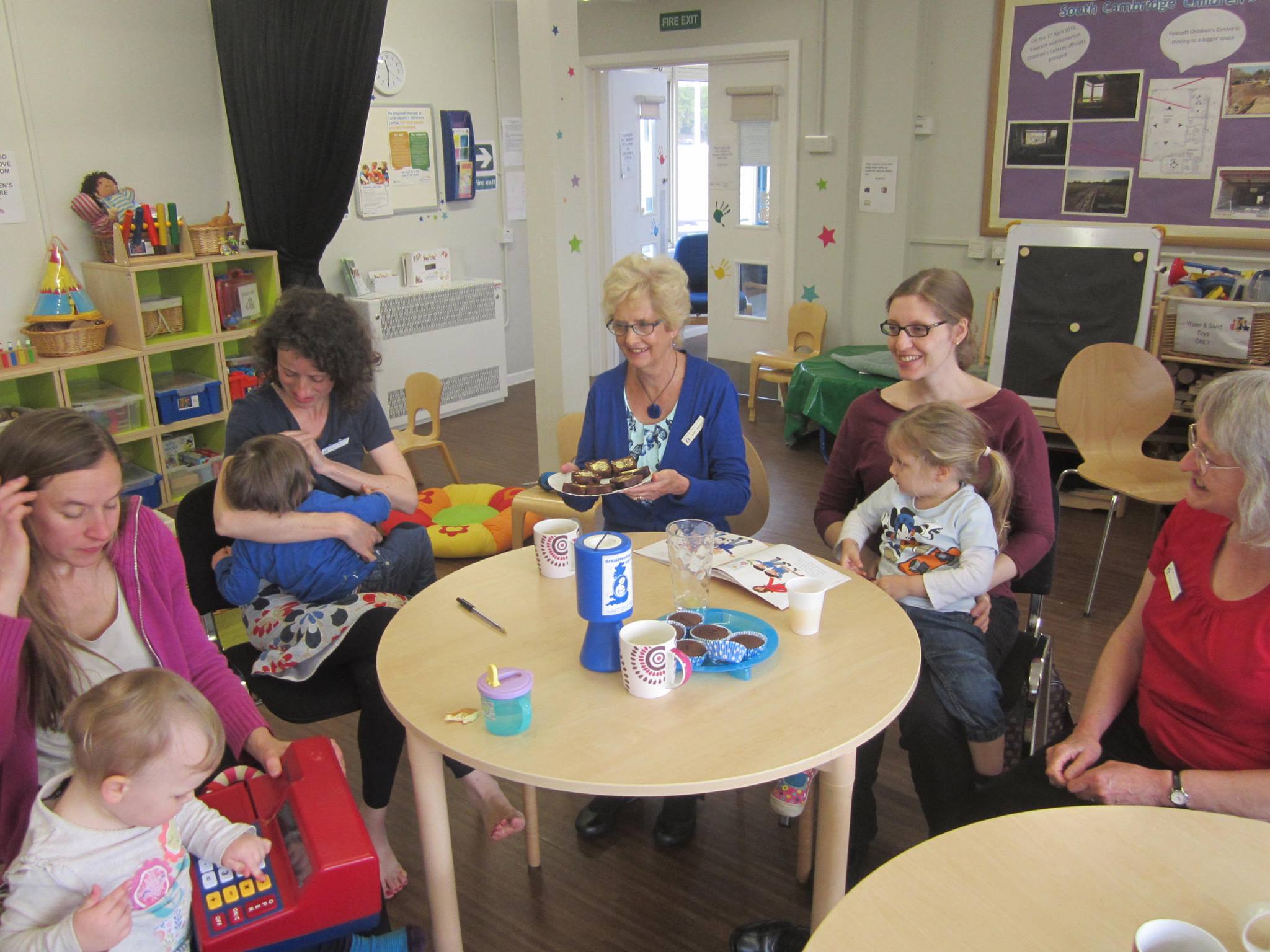
Adjournment debate in UK Parliament on infant feeding

Adjournment debate in UK Parliament on infant feeding

On 1 July, Chichester MP Jess Brown-Fuller led her first adjournment debate in the House of Commons Chamber. 

She raised key concerns with the Government, calling for a national strategy for England. In her role as chair of the All-Party Parliamentary Group (APPG) on Infant Feeding she focuses on specific policy areas, beyond her constituency work. She aims to hold the government to account, by raising identified gaps in policy with the relevant government minister. Such debates apply pressure to increase accountability so may lead to a change in the law. 

Jess highlighted her own positive experience of a network of community support when her children were born a decade ago but which is now, at best, patchy or non-existent. She urged the government to implement all eleven Competition and Markets Authority (CMA) final report recommendations to protect families from the current unacceptable exploitation by the infant formula market.

Several MPs supported the debate by sharing both their own experiences and stories from constituents about the importance of skilled breastfeeding support.

WBTi in Parliament

For the first time, the WBTi report was mentioned by a minister on the floor of the House of Commons. Ashley Dalton, Parliamentary Under-Secretary of State for Public Health and Prevention in the Department of Health and Social Care, replied on behalf of the government:

 “We recognise the concerns raised in the World Breastfeeding Trends Initiative’s United Kingdom report and are considering the recommendations” and “we know through the report that England scores poorly, and we want to change that.” See Column 260 in the Hansard report of the debate.

MPs who attended:

Maya Ellis, Labour MP Ribble Valley

Jim Shannon, DUP MP Strangford ( Northern Ireland ) 

Connor Rand, Labour MP Altrincham and Sale West

Samantha Niblett, Labour MP South Derbyshire

David Reed, Conservative MP Exmouth and Exeter East

David Chadwick, Liberal Democrat MP Brecon Radnor and Cwm Tawe (Wales)

Dr Danny Chamber, Liberal Democrat Winchester
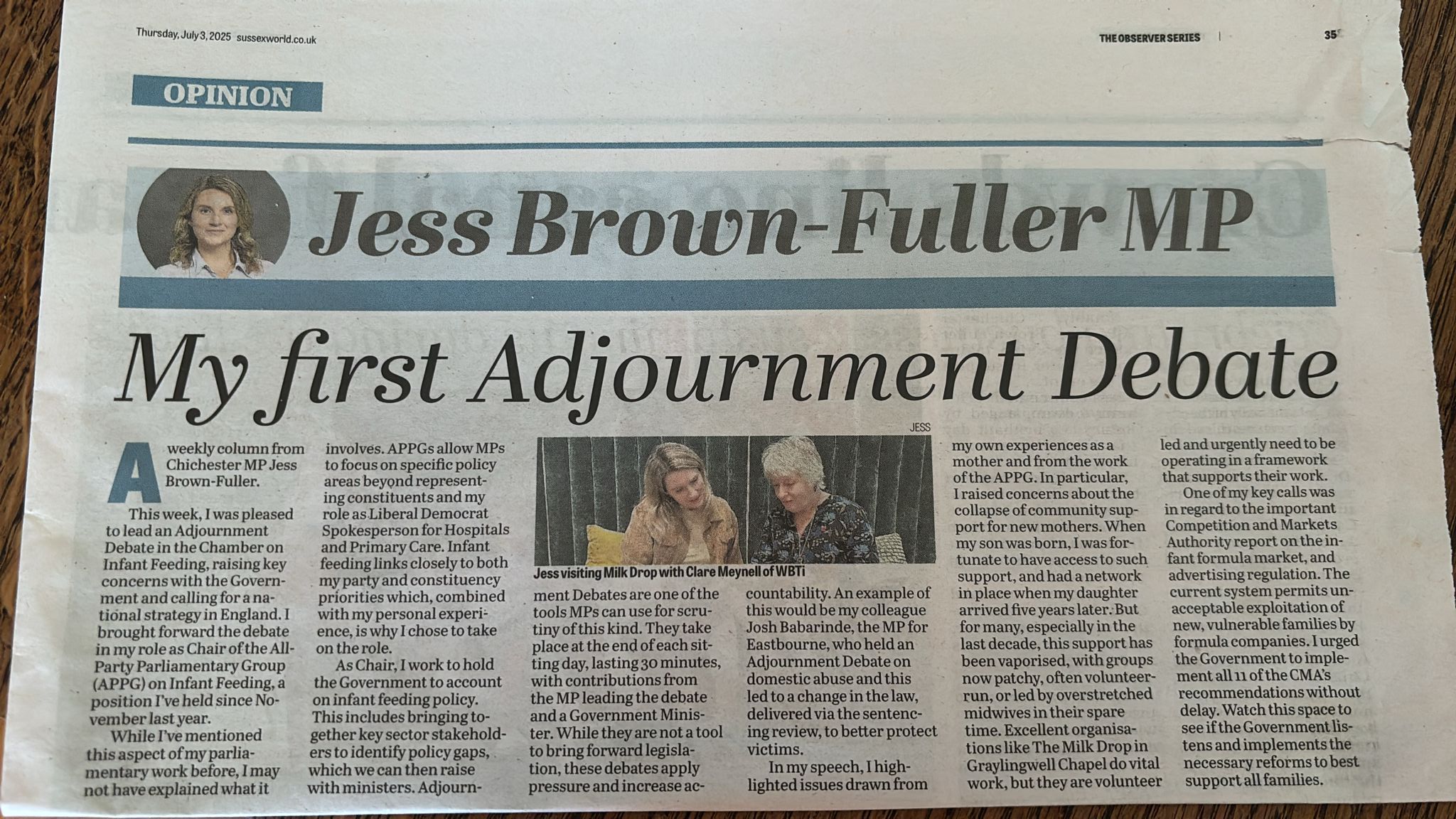
Article in the Sussex Express

Media follow-up

An article in The Independent on 11th August by journalist Abbie Llewellyn followed up on the Adjournment Debate.

Other outlets which picked up on the WBTi Report launch and the debate:

ITV Regional News interviewed Jess Brown-Fuller regarding the outcome of the CMA report, (a market study on infant formula and follow-on formula) set to be released on 1st September 2025.

The i Paper ran an article by journalist Emma Morgan on infant formula marketing.

Parliament News magazine ran a piece by Jess Brown-Fuller MP: Building the ‘healthiest generation ever’ starts with making sure every child has a fair start in life.

The Nursing Times published an article about the WBTi Report launch and policy event, hosted by Jess Brown Fuller, highlighting quotes from iHV CEO Alison Morton, Vicky Sibson of First Steps Nutrition Trust, and Jess Brown-Fuller.

The British Medical Journal on 26 June included a further news article by Gareth Iacobucci, about the WBTi launch and our Call to Action for the government to implement the CMA recommendations in full: “Formula milk: Overpriced and misleading products are risking child health, say campaigners.” BMJ 2025; 389:r1333.

Other recent relevant contributions by Jess Brown-Fuller MP to Parliamentary debates 

Prior to the Adjournment debate on 1st July there was a Parental Leave Review debate led by Justin Madders MP, the Parliamentary Under-Secretary of State for Business and Trade. Various members of the APPG on Infant Feeding attended the meeting. Jess Brown-Fuller asked about the impact of breastfeeding policies on mothers returning to work. Despite the WBTi findings that mothers are struggling with continuing to breastfeed upon return to work, Justin Madders explained that this fell slightly outside the scope of the review but he was happy to correspond on the matter.

On 7th July there was a debate on Giving Every Child the Best Start in Life Strategy, led by Bridget Phillipson MP, Secretary of State for Education. Jess Brown-Fuller asked for confirmation that Best Start centres will be firmly rooted in evidence-based feeding support. The Secretary of State gave an assurance. 

Photo credit: Office of Jess Brown-Fuller MP

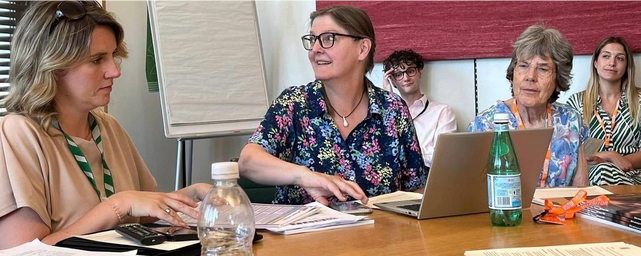
Jess Brown-Fuller MP looking at the WBTi Report with Clare Meynell

Author: Clare Meynell RM (rtd), IBCLC

Clare had a long career as a midwife and infant feeding lead achieving the UNICEF UK Baby Friendly Initiative Gold award accreditation at her local hospital. Currently, with Helen Gray, she jointly coordinates the UK WBTI working group and co-presented the first report for the UK in Parliament in November 2016 and the second in 2024.

Clare still volunteers her knowledge and experience at a regular mother and baby support group. 

Her focus recently has been to create “Actions for Change” through the WBTi report recommendations so that the next generation of mothers are enabled to achieve their personal breastfeeding goals and that society better understands the health-giving properties of human milk as the physiologically normal first food for babies. 

Presentation at the APPG on Infant Feeding

Presentation at the APPG on Infant Feeding

WBTi UK Steering Group members, Helen, Clare, Alison and Patricia, were very pleased to be invited to give a presentation on the 2024 Report to the All-Party Parliamentary Group (APPG) on Infant Feeding on 18 June, 2025. This APPG, an informal cross-party group, is hosted by Liberal Democrat MP for Chichester, Jess Brown-Fuller, who is a staunch advocate for breastfeeding. Meetings are quarterly.

(left to right) Jess Brown-Fuller MP, Helen and Patricia during the presentation

The hybrid event was held in Portcullis House, which is close to the Houses of Parliament and overlooks the River Thames.

At the meeting, Helen and Patricia gave an overview of the Report’s findings. This triggered a range of questions from the audience in the room and online. Attendees included Labour MP for Ribble Valley, Maya Ellis, and Liberal Democrat MP for mid-Sussex, Alison Bennett, along with representatives of Royal Colleges and local public health teams, as well as the breastfeeding support organisations.

(left to right) Jayne Joyce and Emily Lunny (LLLGB), Helen Gray and Patricia Wise (WBTi Steering Group) and Katie Pereira-Kotze (First Steps Nutrition Trust)

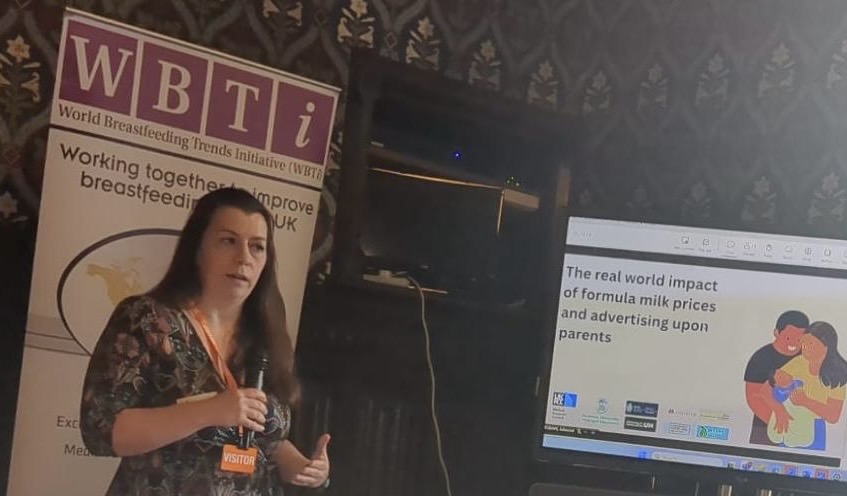
Presentation title slide

APPG meetings

If you would like to be notified about future Infant Feeding APPG meetings, please contact Edmund Legrave, Parliamentary Assistant for Jess Fuller-Brown: edmund.legrave@parliament.uk

Author: Patricia Wise

Patricia Wise is an NCT Breastfeeding counsellor and a member of the WBTi UK Steering Group. She has a particular interest in health professional training in breastfeeding and her e-book, Supporting mothers who breastfeed: a guide for trainee and qualified doctors, is available on the WBTi website. 

New WBTi Report: Parliamentary launch

New WBTi Report: Parliamentary launch

Jess Brown-Fuller, MP for Chichester, hosted the formal launch of the WBTi 2024 UK report on July 24th 2025 in the Jubilee Room at the Houses of Parliament. 

(left to right) Patricia Wise, Clare Meynell, Jess Brown-Fuller MP with visiting baby Niamh, Helen Gray, Alison Spiro

Kate Quilton

Investigative journalist Kate Quilton drew on her own experiences in emphasising the importance of a  policy framework, and chaired the Q&A.

What do policymakers need to do, to protect and support breastfeeding? 

The WBTi 2024 report made a number of key policy recommendations on maternity rights, marketing regulations and food safety.

WBTi’s ‘big ask’

The aim of the WBTi project is to galvanise action to implement report recommendations, thus improving support and protection for infant feeding. Our single most immediate actionable ask is for the UK and devolved governments to adopt the eleven recommendations of the Competition and Markets Authority (CMA) report on regulating misleading infant formula promotion. Adopting these would help to end the profiteering we have seen in recent years (formula prices have gone up by 24%! including one by 49%!). This would also help families make informed infant feeding decisions and for them to be able to access affordable products to feed their babies if needed.

The CMA recommendations encompass many of the WBTi UK recommendations on protecting families from exploitative marketing. In addition, WBTi calls for the regulations to apply to ALL formulas from 0-36 months. This would help end the loopholes that companies use in the marketing of formulas for older babies and toddlers, or for special medical purposes.

Professor Nigel Rollins

Professor Nigel Rollins, who formerly worked for the World Health Organisation and is now at Queens University, Belfast, gave a policy overview and more details about our ‘Call to Action’. 

Parents are struggling

Professor Amy Brown of Swansea university stunned the room when she revealed some of the shocking findings of her research into the challenges families are facing to afford the high prices of formula.

Professor Amy Brown

Her presentation called for:

  • Lower priced milks – consistent, reliable and affordable pricing
  • Accurate information, not adverts
  • Parents should be supported to feed their baby without worrying about cost
  • For the health and well-being of parents and babies to be put before profits

She shared powerful testimony about the impact of the high cost of formula from parents themselves:

Breastfeeding is important

“Breastfeeding is a human right for both mother and child” (UN human rights joint statement 2016).

WBTi work is built on a foundation of human rights. UN human rights experts have made it clear that breastfeeding is a right of the dyad, the mother and infant together. The rights of one don’t supercede the other; mother and baby have rights as a dyad. It is the responsibility of our governments to support and protect those rights, by providing skilled health care, maternity protection at work, and protecting the rights of women and families to make their own informed decisions about how to feed their baby, without commercial influence.

What is the impact of low breastfeeding rates in the UK?

High costs for the NHS:

Low UK breastfeeding rates are costing the NHS £millions:

  • 54,000 more GP appointments
  • 9,500+ additional hospitalisations

Research has shown that basic interventions to support more mothers to breastfeed for longer could pay for themselves within a year. (Renfrew et al 2012)

Costing our planet:

The formula and dairy industries have a significant footprint both of greenhouse gases and water.

“For the UK alone, carbon emission savings gained by supporting mothers to breastfeeding would equate to taking between 50,000 and 77,500 cars off the road each year” (Joffe et al 2019)

Key recommendations from the WBTi Core Group

Our governments must address the ‘baby blind spots’ in national policies:

  • Protect all infants by adopting in full the recommendations of the CMA, and extending the regulations to cover all infant milks up to 3 years, in order to address current loopholes in marketing formulas for older infants or for special medical purposes.
    • WBTi recommends that regulations on safety and on marketing should be applied to feeding equipment such as bottles, teats, and other equipment, as well.
  • Protect infants and young children in emergencies by developing guidance on their care.
  • Protect the health and the rights of women and children by providing statutory rights for flexible breastfeeding/ expressing breaks and suitable facilities in the workplace and in education.
  • Develop a national infant feeding strategy and leadership for England.
  • Improve monitoring and evaluation by strengthening and coordinating data collection systems.

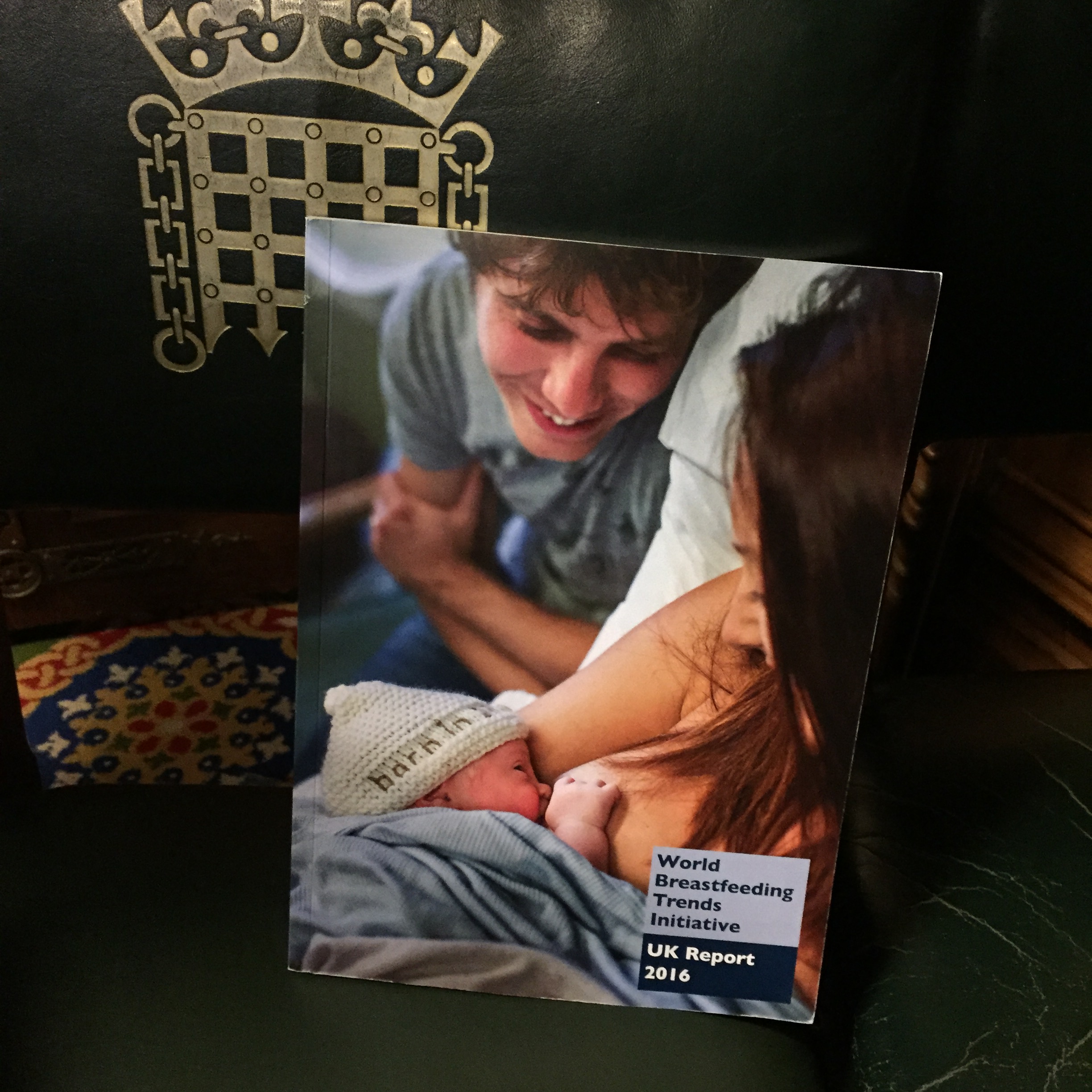
Find our 2016 and 2024 reports here.

Sign up for our mailing list here (we send very few emails! And never share your details).

Donate to support our work here.

Author: Helen Gray

Helen is a member of the Steering Group for  the World Breastfeeding Trends Initiative (WBTi) project in the UK.

An IBCLC and La Leche League Leader (breastfeeding counsellor), she has served as both Communications Co-Chair and Policy and Advocacy Lead for Lactation Consultants of Great Britain. She represents La Leche League of Great Britain on the UK Baby Feeding Law Group (BFLG), which works to bring the International Code of Marketing of Breastmilk Substitutes into UK law.

Helen’s background in anthropology and human evolution has influenced her interest in how breastfeeding and the way we nurture our babies are influenced by both human biology and culture.

She is currently doing a research degree on the need for strong policies to protect infant feeding in emergencies. She has written several articles and chapters on the subject and served on the Advisory Panel for a London Food Resilience research project. She now represents BFLG on the global Infant Feeding in Emergencies Core Group.

‘Let’s make breastfeeding work – optimal maternity leave and workplace accommodations support an environment that enables breastfeeding’

August 1-7th marks the World Breastfeeding Week. The theme is ‘Let’s make breastfeeding and work, work!’ The benefit of breastfeeding to health, the economy, work and the environment is widely documented. However, the UK remains one of the countries in the world with the lowest breastfeeding rate. Although 81% of mothers set out to breastfeed, only 1% of babies in the UK are still exclusively breastfed at 6 months. The question has always been why is breastfeeding rate so low in the UK? 

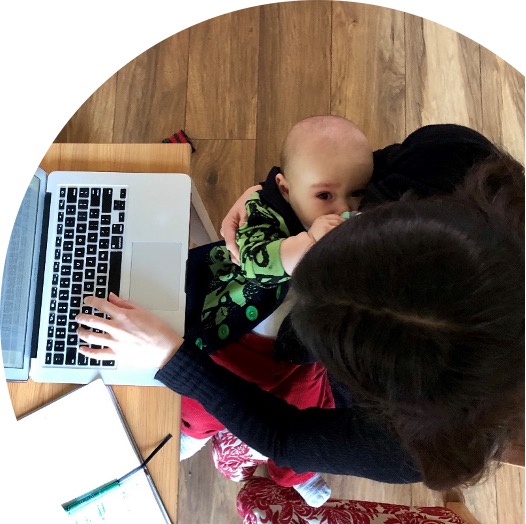
Photo credit: Dr Paige E. Davis

Return to work is one of the key barriers to breastfeeding especially where the workplace is not breastfeeding friendly. A study published in 2007 by the Cohort Group found that mothers employed part-time or self-employed were more likely to breast-feed for at least 4 months than those employed full-time. The longer a mother delayed her return to work postpartum, the more likely she was to breast-feed for at least 4 months. Mothers were more likely to breastfeed for at least 4 months if their employer offered family-friendly or flexible work arrangements, or they received Statutory Maternity Pay plus additional pay during their maternity leave rather than Statutory Maternity Pay alone. This demonstrated that return to work could have a negative impact on breastfeeding if the mother is not properly supported. 

Currently the UK does not have a legal framework that protects and promote breastfeeding in the workplace. The 1001 critical days strategy is there but does not have a legal backing to ensure that mothers are properly supported to continue breastfeeding should they choose to return to work early. A general assumption is made that mothers would take the full 52 weeks of maternity leave even though the leave is not properly paid.  Mothers returning to work find it challenging to understand what they can and cannot do. 

Though many employers are quick to showcase how family friendly they are in supporting working parents, breastfeeding remains an area in need of significant improvement. This is predominantly because the government has failed to recognise the benefits of breastfeeding and has failed to embed it in the current family friendly rights. Ideally, maternity leave should naturally go with a workplace breastfeeding policy. Other family friendly policies such as shared parental leave is not achieving its desired impact partly because of the lack of breastfeeding support in the workplace. 

Mothers who intend to breastfeed for long may not share their maternity leave with their partners if support is not in place in the workplace.

These challenges were clearly articulates in the breastfeeding documentary titled ‘Breastfeeding: Not on the Agenda’which was followed by a call to action for the government to include breastfeeding in the family friendly rights to Make Breastfeeding and Work, Work.

NOTE from the WBTi team:

This petition incorporates many of the WBTi recommendations for action:

  • Embed breastfeeding in the school curriculum and relevant health  professionals training.
  • Provide a policy on breastfeeding in the workplace which will protect the rights of breastfeeding mothers in the workplace.
  • Mandate all large public places like shopping malls, community centres, public libraries, museums, etc to provide breastfeeding rooms or spaces.
  • Fully adopt The Code of Marketing of Breastmilk Substitutes to protect babies and their families from harmful commercial influences and undermining of breastfeeding for commercial profit; and to protect families who formula feed from the escalating costs of premium brands.
  • Provide adequate 24/7 specialist lactation support in maternity services to actively counteract the culture of formula top-ups in hospitals; and to enable human donor milk to be more accessible as an option when mother’s milk is not immediately available.
  • Guarantee a sustained funding support to breastfeeding organisations who play a key part in supporting mothers.
  • Include breastfeeding support on the Net Zero Environmental Agenda.

Dr Ernestine Gheyoh Ndzi is the Associate Dean for Law and Police Studies at York St John University. Her research interest lies in Company Law and Employment Law. Ernestine has in the past four years been researching on shared parental leave and breastfeeding. Ernestine is a member of the Board of Trustees for The Breastfeeding Network. She is the producer of the breastfeeding documentary titled ‘Breastfeeding: Not on the Agenda. She is running a 9-webinar series exploring the benefits and challenges of breastfeeding. She is also leading on the campaign for change to support breastfeeding in the UK.


Infant Feeding in Emergencies – Resources for supporting families from #Ukraine #IYCFE

Infant Feeding in Emergencies – Resources for supporting families from #Ukraine #IYCFE

Our WBTi work has revealed that in the UK we have no national guidance on the support and feeding of infants and young children, or pregnant or breastfeeding mothers, during emergencies. There is currently a postcode lottery of Local Resilience Forums who include a few details in their advice to the public such as “Remember to pack formula and nappies for your baby”, but there is no national guidance for LRFs and local authorities that they should include infants and young children in their planning.

This page will serve as a repository for resources for those planning services and those providing feeding support for Ukrainian families with infants and young children.

Breastfeeding provides infants with food security, immune protection, and emotional comfort during disasters.
Basic priorities in an emergency:

1) Support new mothers to hold their babies skin to skin and begin breastfeeding within the first hour.

2) Support mothers who are breastfeeding, partially or fully breastfeeding, to continue breastfeeding and increase their milk supply if needed: provide access to skilled feeding support.

3) Protect infants who are not breastfed: Trained infant feeding / nutrition support teams from trusted NGOs like UNICEF will provide access to safe supplies of appropriate infant formula for babies that need it, and support with safe preparation under hazardous conditions.

4) Protect all infants: breastmilk substitutes and feeding equipment (infant formulas and other milks, bottles, teats, breast pumps and also donor human milk) will be provided by trusted NGOs like UNICEF; the public should AVOID sending donations of these into high risk settings, but send donations of funds to trusted NGOS instead. This will enable them to provide families with what is needed on the ground.

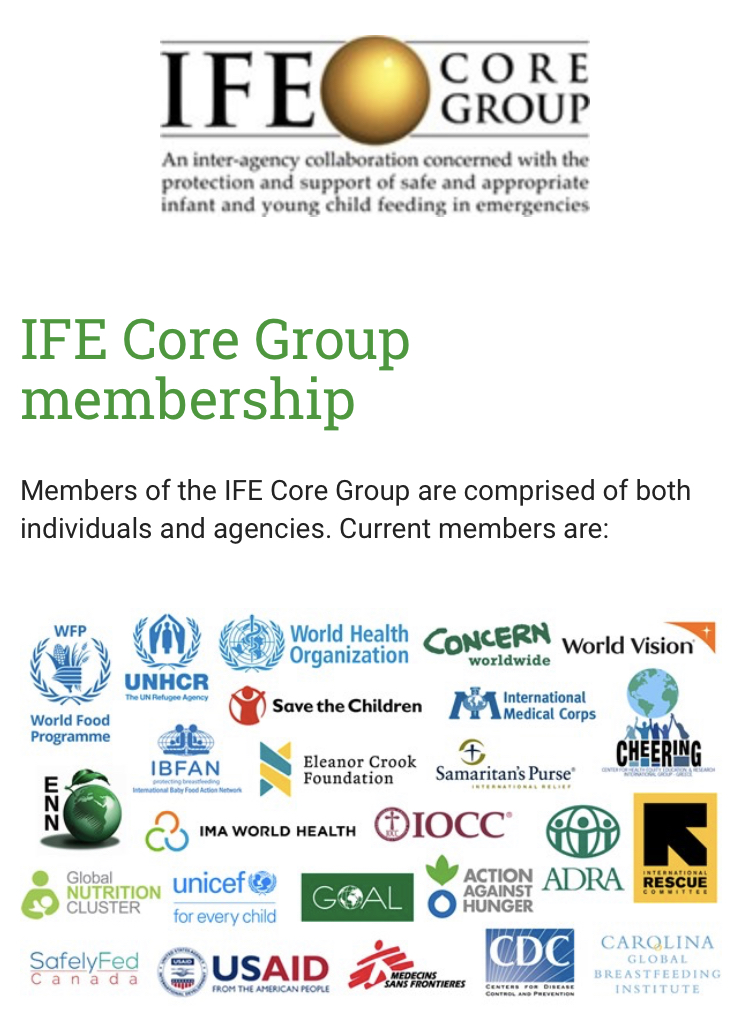
These organisations are members of the Infant Feeding in Emergencies Core Group and have created the international Operational Guidance on Infant Feeding in Emergencies. Please consider supporting their work with families with infants and young children.

We have collected links to infant feeding resources in Ukrainian, and also in the languages of countries housing refugee families, for breastfeeding helpers and aid workers in those countries.

Please send us any suggestions for additional resources

We have a few other resources not included here; please email us any enquiries.

NOTE: we will continue to add links and resources to this page, and these organisations are continuing to add further translations into more languages – please make sure that you clear your cache, or ‘refresh’ the page, each time you open any of these links to ensure that you find the most up to date page.

NOTE: We are providing these resources as a public service, but we cannot read the resources in other languages ourselves, so we cannot always vouch for the accuracy of the contents. Please have someone fluent in the language read it for you.

CONTACT: wbti@ukbreastfeeding.org

WHERE TO START? Watch this 4 minute introductory video from Save the Children

Aid worker or emergency planner? Short video here: how can you incorporate best practice into your support for Ukrainian families?

GET INFORMED: Read the first 25 pages of the Guidance for an overview of best practice.

Resources from the Global Breastfeeding Collective, led by WHO and UNICEF

It is important to continue breastfeeding if you are COVID positive: your milk can pass antibodies to your baby! More resources HERE.

UNICEF UK Baby Friendly resources

Guidance for local authorities on infant feeding during COVID19 (from BFI, First Steps Nutrition Trust, and NIFN). First line guidance for UK local authorities responsible for supporting families

The provision of formula in food banks (November 2020)

Statement on infant formula in food banks (November 2020) – signposting

See also the response to Question 11 on formula donations and distribution in their FAQ here

International humanitarian guidelines and operational guidance

Sphere Handbook

Operational Guidance on Infant feeding in Emergencies
for Emergency Relief Staff and Programme Managers

Available in numerous languages

Media Guide and Guide on writing/ talking about infant feeding in emergencies
These are extremely useful for humanitarian aid organisations and for the media in framing the situation

Guidance for helpers not trained in supporting infant feeding

This short leaflet was written for local authorities and those supporting Afghan refugee families but could be useful for those supporting Ukrainian refugees in the UK. It sets the context, lists some useful resources for parents, provides information about making up powdered infant formula correctly and describes useful actions in some possible scenarios.

Infant feeding support resources – multiple languages

Rapid Feeding Assessment Key Phrases in multiple languages (including Ukrainian, Russian, Romanian, Polish and English – scroll down the page)

Simple Points for Helpers – infant feeding in emergencies in multiple languages (including Ukrainian, Russian, Romanian, Polish and English – scroll down the page)


Pictorial counselling cards in many languages including Russian, adapted to include COVID19 recommendations. Some are full pictorial sets, while some are simply the translation matrix.

Infant Feeding flyer for families in transit (including English, Ukrainian, Polish, Russian, updated for COVID19). Developed by the volunteer team from Infant Feeding Support for Refugee Children/ Safely Fed

Posters and booklets in Ukrainian hosted by the Lithuanian IBCLC Association

Pictorial book about breastfeeding (no words) from La Leche League Netherlands. The PDF is free to use for all. Printing and sharing is allowed, as long as the original file (including credits) is unaltered. Price listed on website is for printed version.

Breastfeeding resources in multiple languages including Ukrainian, Romanian, Russian. (From the Missouri Department of Health and Senior Services, USA)

Breastfeeding Matters – A Guide to Breastfeeding for Women and their Families (from best Start, Ontario Canada) can be downloaded free in Russian and other languages

Translations of key phrases, breastfeeding infographics in many languages, and more: Safely Fed European resources

La Leche League International: Variety of resources and infographics in infant feeding in emergencies translated into multiple languages – most are directed at mothers and parents

Global Health Media: Videos on childbirth and breastfeeding topics.

Infant Feeding in Emergencies Social Media resources:

Infant Feeding Support for Refugee Children Facebook Page: Memes/ graphics in multiple languages, with appropriate captions

La Leche League International Facebook page: Memes/ graphics in multiple languages, aimed at mothers and parents

Safely Fed UK Facebook page – volunteers welcome to create graphics in Canva and to monitor the page! Contact WBTi UK: wbti@ukbreastfeeding.org

For policy makers, emergency planners, media and humanitarian aid workers

Policy resources, media guide, training materials: Infant Feeding in Emergencies Core Group

IYCFE Hub: global hub of resources

Background information on breastfeeding in Ukraine: WBTi 2015 Ukraine Assessment Report

Policy resources, translations of key phrases, and more: Safely Fed European resources

Please do contact us if you are interested in volunteering or have some useful resources to share!!

CONTACT: wbti@ukbreastfeeding.org

Helen Gray MPhil IBCLC is Joint Coordinator of the WBTI UK Steering Team, and Policy and Advocacy Lead at Lactation Consultants of Great Britain. Her research interests include human rights and infant and young child feeding in emergencies.

Protecting babies in emergencies

Protecting babies in emergencies

Guidance is needed on infant and young child feeding for families in the UK affected by disasters and emergencies.

Heather Trickey and Helen Gray.

Disaster and emergency situations – floods, fires, terrorist attacks and widespread power failures – can affect any country, including the UK. In any disaster or emergency, babies are vulnerable and continued access to adequate and safe nutrition is essential. Families need support to ensure that children continue to be cared for and fed in line with their needs.


There is no UK government plan

The World Health Assembly (WHA Resolution 63.23) has recommended that all countries implement existing global guidelines on infant feeding during emergencies, including specific operational guidance to help relief agencies protect infant nutrition and minimise risk of infection. Although there is national guidance on care of animals during emergencies, a recent World Breastfeeding Trends Initiative (WBTi) report found that there are no UK-wide or national strategies addressing infant and young child feeding during a disaster. Scotland is the only part of the UK that has a named lead on infant feeding in emergencies. Emergency planning and response is devolved to local authorities; because there is no guidance on the protection of families with infants there is no way to ensure that local strategies consider infant nutrition as part of emergency response.


Risks for formula fed babies

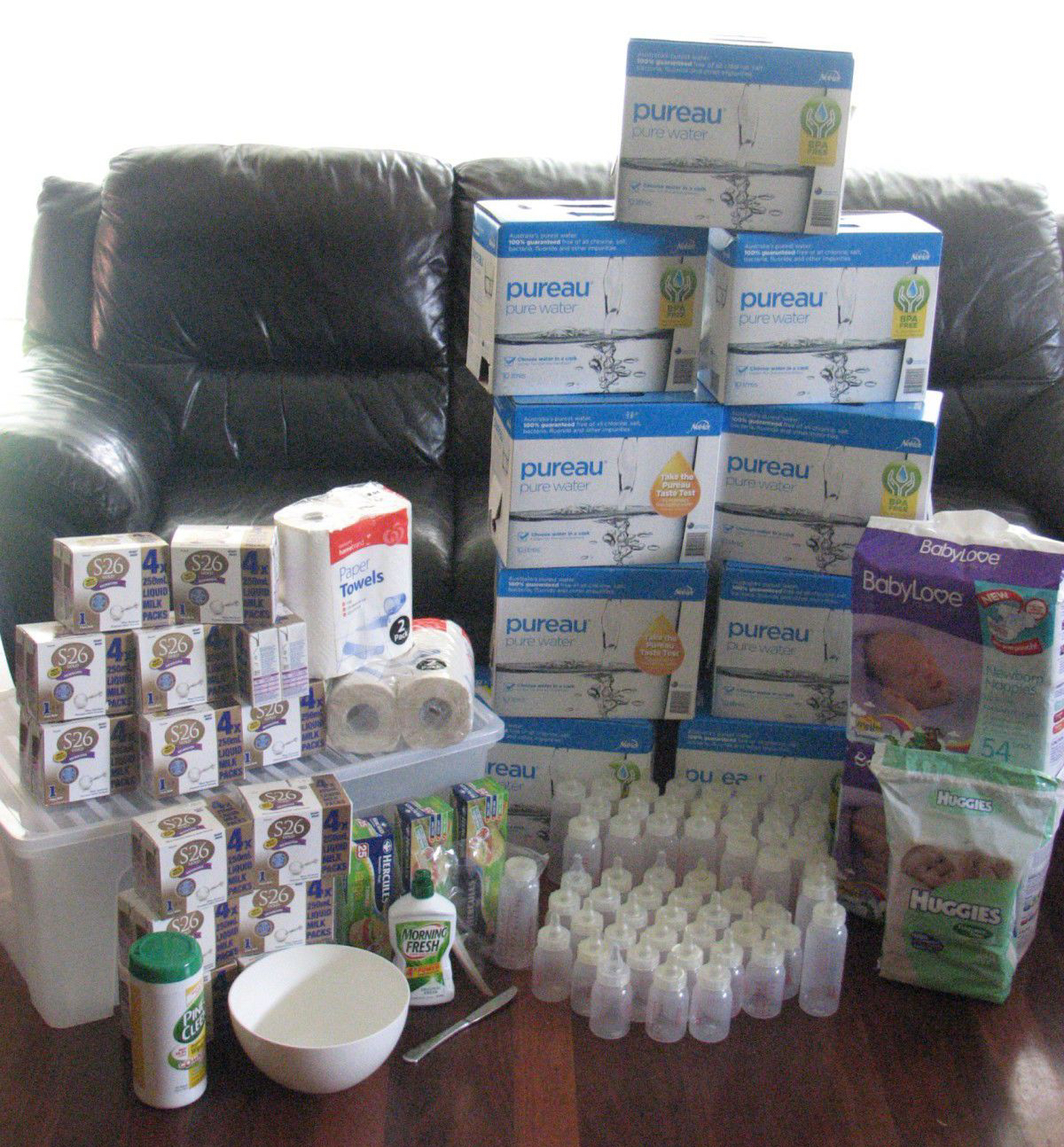
Babies who are fully or partially formula fed are at risk if their caregivers lose access to clean water, are unable to sterilise feeding equipment or suffer disruption or contamination of their formula milk supplies. A suitable environment for preparation and storage of feeds, sterilising equipment, boiling water and safe storage such as a refrigerator, are all needed to prevent bacterial contamination

Gribble IYCFE liquid photo 13006_2011_Article_127_Fig2_HTML
Emergency supplies required to care for and feed a formula fed baby for one week in a developed country, using read-to-feed milk. From Gribble & Berry 2011 “Emergency Preparedness for those who care for infants in developed country contexts.” International Breastfeeding Journal /2011 6:16

Risks for breastfed babies

Breastfeeding protects against infection and can be comforting to infants and mothers during difficult times. Mothers’ supply of breastmilk is resilient, however, chaos, displacement and emotional strain, coupled with commonly held misconceptions about how breastfeeding works, can undermine a mother’s confidence and result in less frequent feeding. Breastfeeding mothers need access to the option of feeding in a private space and reassurance that continuing to breastfeed is the best option for their baby.

Skilled support can help mothers resolve breastfeeding problems and maintain the protective effect of full or partial breastfeeding. If breastfeeding helpers are not pre-authorised as part of planned disaster response the immediate help that families need can be delayed.


Risks associated with donated formula milk

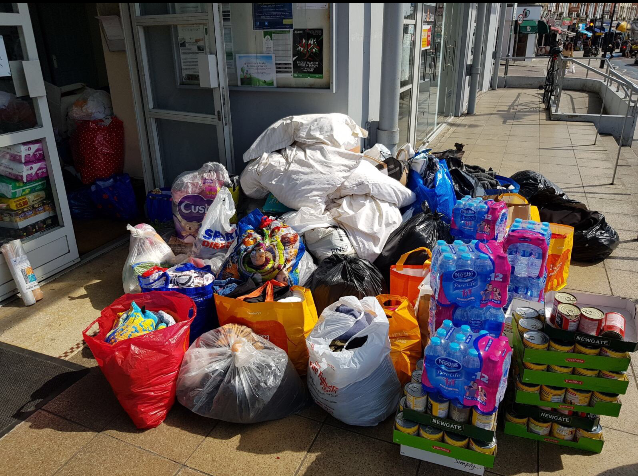
The world is a better place than we sometimes think. When a disaster strikes, ordinary people often respond with an outpouring of generosity. We give clothes, equipment and food spontaneously and in response to public calls.

Donations Balham Mosque
Donations of clothing, bedding, toys, food and water, London, June 2017. Photo Credit: @balhammosque

In the absence of guidance, agencies responsible for co-ordinating emergency response and volunteers working on the front line are often not aware that donations of formula milk can put babies at risk. Risks from donated formula milk include inadvertently distributing products that are unsuitable for babies under six months or for babies with special nutritional needs, as well as distributing milk that is contaminated or out-of-date. There is also a risk that donations will be inappropriately provided to parents of breastfed babies, which can undermine the protective effect of breastfeeding and cause parents to become dependent on a continued supply of formula milk.

International guidelines for emergency feeding caution against accepting donations of formula milk. It is recommended that emergency planners and first responders, with expert advice, take responsibility for purchase and distribution of appropriate formula milks in line with the needs of each family.


What’s been done so far?

International guidelines for protecting infants in disasters and emergencies are available.  There is a need to adapt these to a UK context, where, beyond the early weeks, many babies are fully or partially formula fed and which includes a rich mix of cultures and nationalities with different feeding practices.

UK-based emergencies have tended to be highly localised and short-term. However, UK guidance will need to ensure preparedness for longer-term support needs, for UK charities and for displaced families and unaccompanied children who have sought refuge from outside of the UK.

Several UK agencies have developed guidance with limited scope. The Food Safety Agency has issued guidance to support safe preparation of formula milk in response to flooding and contamination of local water supplies.  [20222 update: UNICEF UK Baby Friendly Initiative has produced guidance for Local Authorities on supporting families with infants who are experiencing food insecurity]

[2021 update: See also the infographic series from the Infant Feeding in Emergencies Core Group on managing appropriate infant feeding interventions during emergencies, including Preventing and managing inappropriate donations during emergencies: https://www.ennonline.net/ifecoregroupinfographicseries


Preventing and managing inappropriate donations during emergencies 2021. From the Infant Feeding Core Group https://www.ennonline.net/attachments/4050/Preventing-and-Managing-Inappropriate-Donations.pdf


How to help ensure babies’ nutritional needs are protected

In the absence of national guidance, relief co-ordinators and agencies and members of the public will be concerned to do the right thing in response to a disaster. There is an urgent need to improve planning and raise awareness about the best ways to support infant and child feeding. These key points from have been adapted from UK and international guidance:


1) Members of the public

  • DO donate money to key agencies. This is the best way to support parents who need to buy formula milk. Money will allow parents, caregivers or coordinating aid organisations to buy the most appropriate milk to meet the individual needs of each baby. Donated formula milk can inadvertently put babies at risk.
  • DO offer your time to help agencies co-ordinating relief. Support and encourage mothers who are breastfeeding. Breastfeeding is protective against infection, and provides the baby with the safest possible nutrition.

2) Relief workers and aid agencies

  • DO have a local plan to support infant and young child feeding in emergencies in place for local authorities, first responders and aid agencies. All families should be screened to ensure they receive appropriate support or supplies.
  • DO ensure that mothers who are fully or partially breastfeeding have the support they need to continue. Mothers can seek support from their midwife or health visitor. Local emergency planning should have identified appropriate infant feeding support from local health and voluntary services. There are telephone helplines which support caregivers with all aspects of infant feeding:
    • NCT helpline (0300 330 0700)
    • The National Breastfeeding Helpline (0300 100 0212).
  • DO encourage donations of money to recognised agencies so that parents, caregivers and agencies can buy any formula or supplies needed, rather than donations of formula products.
  • Appropriate support or supplies including cash cards specifically for the purchase of infant formula and complementary foods for young children could be considered.
  • DO ensure that formula milk is purchased and distributed only for babies who need formula milk, following basic screening of families (simple triage tools have been recently been developed for use in emergency situations in Greece and Canada).
  • DO NOT distribute formula milk in an untargeted way.
  • DO ensure that parents are aware of guidance on sterilisation of bottles and teats and how to prepare any powdered formula safely and have access to facilities to carry this out, to reduce the risk of contamination. Liquid ready-to-feed formula may be needed if suitable preparation facilities are not available.

What is needed now?

There is an urgent need for UK governments to ensure infant and child nutrition is protected as part of the planned new strategy for resilience in major disasters. Local authorities and relief agencies require national guidance to develop local strategies so that we can all be better prepared.


Heather Trickey is a Research Associate based in DECIPHer, Cardiff University. Her research focuses on public health policy and parents, particularly Infant Feeding Policy.

Helen Gray is Joint Coordinator of the World Breastfeeding Trends (WBTi) UK Working Group.

The first World Breastfeeding Trends Initiative UK report is launched!

commonsThe launch at the House of Commons on 15 November of the first UK-wide World Breastfeeding Trends Initiative (WBTi) report on infant feeding policies and programmes gave some clues to which “stepping stones” along a family’s feeding journey are missing, where families are struggling to meet their own breastfeeding goals. While most mothers in the UK (around 80%) do set out to breastfeed, breastfeeding rates plummet within weeks until fewer than 1% of babies in the UK are exclusively breastfed at 6 months.

MPs from across the political spectrum attended the parliamentary launch, hosted by Alison Thewliss MP, along with guests from Unicef UK Baby Friendly Initiative (who provided a screening of their new short video on their Call to Action) health professional bodies, voluntary organisations, breastfeeding experts and academic researchers. Nearly 20 organisations were involved in developing the report’s recommendations for action.

These recommendations cover the family’s whole feeding journey, and range from the fundamental importance of full Unicef UK Baby Friendly accreditation of maternity settings, to health professional training and access to skilled breastfeeding support in the community, all the way to maternity protection and the provision of breastfeeding breaks in the workplace.

Dr Amy Brown gave a keynote address demonstrating how the structure of joined up policies and programmes forms essential underpinning to the cultural change that is badly needed in the UK.

Lack of political and national leadership, uneven health professional training, formula milk marketing, poor data collection and patchy community support for mothers were identified as gaps in UK policies and programmes. The degree of variability in the minimum standards of training in infant and young child feeding training among different health professions – even those working most closely with mothers and infants – was surprising.

Eyebrows were also raised at finding that, while there is guidance on the care of zoo and circus animals in case of emergency or disaster, there is no national guidance for the care of mothers and babies in an emergency situation. Formula-fed babies would be at particular risk if access to clean water and electricity were interrupted, and it is vital that national guidance be communicated to all local authorities and emergency responders.

Scotland and Northern Ireland were found to have strong strategies and national leadership in place, but England and Wales fell short.

nicola-blackwood
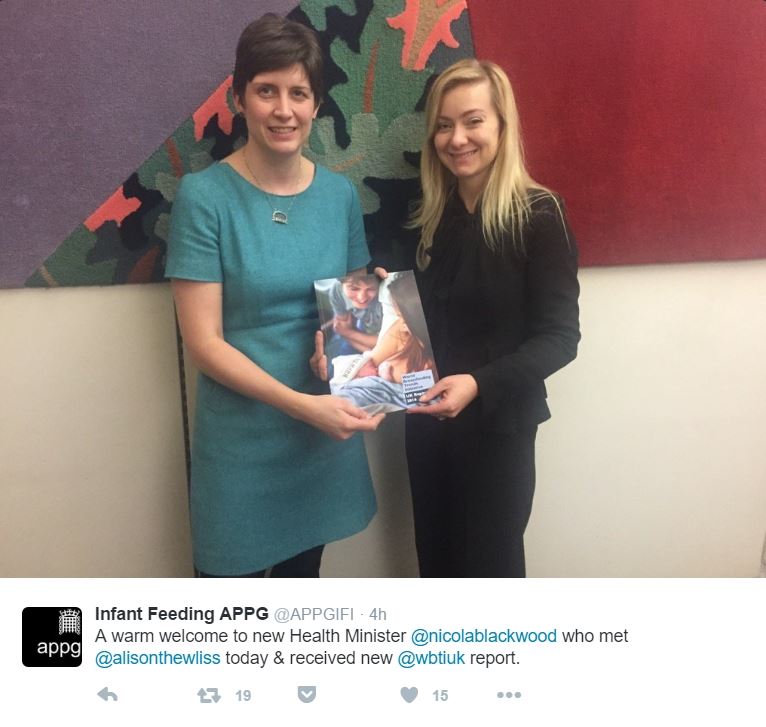
Alison Thewliss MP, chair of the All Party Parliamentary Group on Infant Feeding, hands the new WBTi UK Report to Nicola Blackwood MP, the Minister for Public Health

The Unicef UK Baby Friendly Initiative, however, was singled out as a “world leader” in its commitment to children’s rights and for the excellence of its training programmes, both in hospital settings and in the NICU and community.

The report provides the first broad-based assessment of the UK’s implementation of ten key policies and programmes to support women and babies during their feeding journey. The policies are drawn from the World Health Organisation’s (WHO) Global Strategy for Infant and Young Child Feeding, which the UK has endorsed since 2003.

Some of the recommendations from the WBTi Core Group were actions that MPs could lead on, including the full implementation in UK law the International Code of Marketing of Breastmilk Substitutes as well as its full enforcement, and the protection of breaks for breastfeeding or expressing milk for mothers returning to work. Recent studies from Save the Children and WHO have also shown that political will is pivotal in driving forward improvement in key strategies across the board to support infant feeding.

One of the key drivers for the WBTi project in the UK is women’s choices. Although the majority of mothers in the UK want to breastfeed, many of them are struggling. The majority of these mothers wanted to breastfeed for longer but did not get the support they needed to meet their goals. Mothers who stop breastfeeding early due to unresolved problems have double the risk of postnatal depression.

The impact of infant feeding on child and maternal health is well documented, but the impact on the national economy is less well understood. In addition to costing the NHS more than £40 million for five common diseases alone, the long-term impact of the UK’s low breastfeeding rates on cognitive ability, human capital and productivity across the whole population is estimated to cost the economy at least 0.53% of gross national income.

Breastfeeding rates in the UK are lowest in its most-deprived communities, exacerbating health inequalities. Breastfeeding could prove to be a powerful means of combating inequality.

The environmental footprint of formula feeding amounts to nearly 22 kilograms of CO2, and 4700 litres of water, for every kilogram of milk powder produced. [12]

This first WBTi UK report provides a road map for policy makers and commissioners to target gaps in order to provide families with the support they need all the way through their feeding journey.

Supporting mothers to breastfeed – more on Indicators 5 & 6

baby-holding-hand

74 percent of mothers initiated breastfeeding
44 percent of mothers were still breastfeeding at 6–8 weeks

– Public Health Outcomes Framework (England) 2014/15

90 percent of women who stop breastfeeding in the first six weeks report giving up before they wanted to

– David Bull, Executive Director UNICEF UK

Most mothers in the UK want to breastfeed, yet most mothers stop breastfeeding before they want to. Why?

The fact is that while breastfeeding is natural, mothers need skilled support to be able to breastfeed. Yet many of the health professionals who work with mothers and babies do not have the knowledge or skills to help them.

Indicator 5 of the WBTi examines how well healthcare systems support breastfeeding. It looks in detail at the training of all health professionals who interact with mothers and babies – midwives, health visitors, GPs, paediatricians, lactation consultants and others – both before and after they qualify in their profession. You can see the full education checklist here.

It also asks whether health workers understand their responsibilities under the International Code of Marketing of Breast-milk Substitutes, and whether mothers and babies are able to stay together when one of them is sick.

Support for mothers comes from many sources, not just health professionals. It can come from family, friends, the community at large, and particularly breastfeeding peer-support groups. In the UK, these are run by organisations like the Association of Breastfeeding Mothers, Breastfeeding Network, La Leche League, NCT, as well as by the NHS itself. Mothers who have breastfed their own babies – and who have received training to provide breastfeeding support – are able to provide valuable help to new mothers.

In the UK, just 1 percent of babies are exclusively breastfed for the recommended six months. Common reasons that mothers give for stopping breastfeeding include:

  • finding breastfeeding painful
  • concerns about their milk supply
  • conflicting advice from health professionals
  • lack of support

LLL Mother support group
Trained support is needed at all levels, from peer supporters to lactation consultants. Click here for details of the different roles.

Peer supporters are “informed friends” who can help mothers understand what’s normal and help with many common breastfeeding concerns. They offer a compassionate and empathetic ear to new mothers.

This importance of this community-level support is recognised in Indicator 6 of the WBTi, which looks in detail at access to skilled mother support and community outreach. Good peer-support programmes can increase the length of time that mothers exclusively breastfeed their babies. In other words, they can help mothers who want to breastfeed to carry on for as long they choose.

More on Indicator 2 – Baby Friendly Care and Baby-Friendly Hospital Initiative


A baby is born and placed on his mother’s chest. His newborn reflexes kick in and he starts to crawl to her breast, calm and alert. This skin-to-skin contact triggers a surge in oxytocin – the so-called “mothering hormone” – and she responds by instinctively helping him to the breast. He latches on, and her milk flows.

breast crawl

When breastfeeding begins in this uninterrupted way, soon after birth, research shows that babies are more likely to breastfeed well, and mothers tend to continue to breastfeeding for longer.

Now compare this to the typical birth scenario, repeated in so many maternity hospitals:

A baby is born, and her cord is cut. The midwife announces “It’s a girl!” and then wipes the baby clean and wraps her up. Then she passes her to her mother. Then the baby is passed to her father. After a few minutes, the midwife unwraps the screaming baby and puts her on the scales and gives her a vitamin K injection. The baby is dressed and returned to her mother.

It was the recognition of this importance of this first hour that led to the development of the Ten Steps to Successful Breastfeeding – a set of guidelines that became the cornerstone of the Baby Friendly Hospital Initiative, which began in 1992.

The ten steps encompass the practices that are needed to support a “breastfeeding culture” in hospitals. They are:

  1. Have a written breastfeeding policy that is routinely communicated to all health care staff.
  2. Train all health care staff in skills necessary to implement this policy.
  3. Inform all pregnant women about the benefits and management of breastfeeding.
  4. Help mothers initiate breastfeeding within half an hour of birth.
  5. Show mothers how to breastfeed, and how to maintain lactation even if they should be separated from their infants.
  6. Give newborn infants no food or drink other than breast milk, unless medically indicated.
  7. Practise rooming-in – that is, allow mothers and infants to remain together – 24 hours a day.
  8. Encourage breastfeeding on demand.
  9. Give no artificial teats or pacifiers (also called dummies or soothers) to breastfeeding infants.
  10. Foster the establishment of breastfeeding support groups and refer mothers to them on discharge from the hospital or clinic.

In order to call itself “Baby Friendly” a hospital or institution must also adhere to the WHO International Code of Marketing of Breast-milk Substitutes (more on this in the next blog on Indicator 3).

There is clear evidence for better outcomes for babies born in Baby Friendly hospitals – for example, a study in Scotland found that these babies are 28 percent more likely to be exclusively breastfed at 7 days old.

The meaning of Baby Friendly has also evolved over time, and in recent years it has moved beyond the ten steps. In the UK, as well as protecting breastfeeding, the Baby Friendly approach now helps mothers to begin a nurturing relationship with their baby – and this protection applies to all babies, whether or not they are breastfed.

The Baby Friendly Initiative has also moved beyond maternity hospitals. In the UK, it is now possible for university courses, health visitors, children’s centres, and neonatal units to become Baby Friendly accredited.

The World Breastfeeding Trends initiative (WBTi) assessment scores each country out of 5 based on how many Baby Friendly hospitals it has. It needs have more than 89 percent of its hospitals and maternity units accredited to gain the top rating.

The assessment also looks at the quality of the Baby Friendly programme – how comprehensive the training is, whether it monitors hospitals adequately, whether mothers’ experiences are taken into account – for another possible score of 5.

How do you think your local services would score?